Imagine you are a professional athlete or perhaps a weekend gardener. You reach for a tennis ball or a heavy bag of mulch. Suddenly, your shoulder locks. There is a knot, which feels like a hard marble deep within the muscle. This is a trigger point. It radiates pain and restricts your movement. It feels like a literal hitch in your internal machinery.
But how Does Dry Needling Work? exactly does a tiny needle resolve a massive pain? To understand the process, we must look beneath the skin. We need to examine the complex relationship between our nerves and our muscles.
For years, we treated these hitches with rest, heat, or heavy-handed massage. Today, a different approach has gained ground in clinics worldwide. It involves a needle that is thinner than a strand of hair. It also requires a precise understanding of human anatomy. We call this practice dry needling.
Understanding the Myofascial Trigger Point
At the heart of dry needling is the trigger point. Think of your muscle like a well-organized bungee cord. Usually, the fibers slide past each other smoothly. However, a small segment of those fibers can get stuck in a contracted state. This happens due to overuse, poor posture, or sudden injury.
This is not just a simple cramp. It is a localized energy crisis. The muscle fibers are clamped so tight that they squeeze the local capillaries. This action cuts off fresh blood and oxygen. The lack of oxygen causes the muscle to release acidic chemicals. These chemicals irritate your nerves and cause that familiar, dull ache.
The Mechanics of the Needle
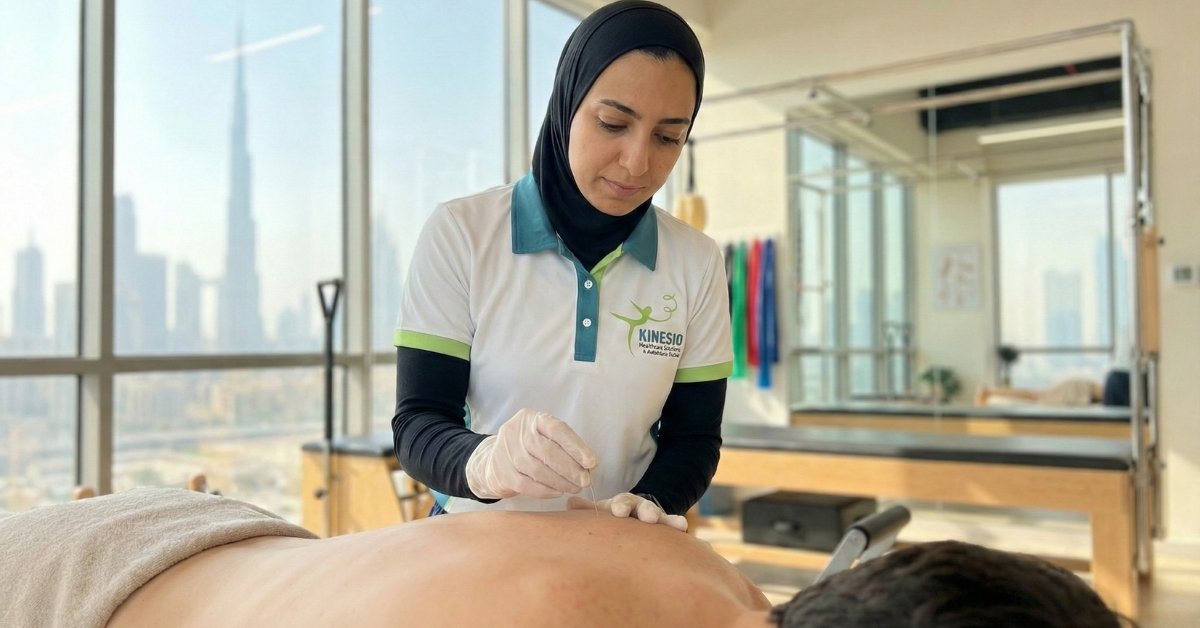
When a physical therapist or clinician performs dry needling, they are not injecting medicine. That is why we call it “dry.” They use a solid filiform needle. This is the same kind used in acupuncture. However, the philosophy behind the two practices differs significantly.
The clinician feels for the taut band of muscle. Once they locate the trigger point, they gently insert the needle directly into it. It sounds intimidating. Yet, the needle is so thin that most patients barely feel it break the skin. The magic happens once the tip of the needle reaches the knot.
Triggering the Local Twitch Response
As the needle enters the trigger point, it often produces a local twitch response. This is an involuntary contraction where the muscle fibers jump or flicker. In the world of clinical practice, this twitch is the gold standard. It tells us we have hit the bullseye.
But why does a twitch matter? Think of it as a hard reset for a frozen computer. The mechanical stimulation of the needle breaks the cycle of contraction. It forces the muscle fibers to let go. This allows the bungee cord to return to its resting length.
Restoring Blood Flow and Chemical Balance
Once the needle breaks the knot, something remarkable happens at a microscopic level. The pressure on the tiny blood vessels is released. Suddenly, fresh and oxygenated blood rushes back into the area.
This fresh blood washes away the acidic chemicals that were irritating the pain receptors. Two of these chemicals are substance P and bradykinin. By changing the chemical environment around the muscle, we are not just masking the pain. Instead, we are physically altering the tissue to stop the pain at its source.
The Neurological Effect: Talking to the Brain
How Does Dry Needling Work? more than just work on the muscle. It also works on the nervous system. When the needle enters the tissue, it sends a high-speed signal to the spinal cord and the brain.
Our bodies have a built-in pain gate. By providing a non-painful stimulus like the needle, we can effectively close the gate on the chronic ache. Furthermore, the brain responds to the how Does Dry Needling Work? by releasing endorphins and enkephalins. These are the body’s natural painkillers. It is an elegant way of using the body’s own internal pharmacy to facilitate healing.
Dry Needling vs. Acupuncture: What is the Difference?
It is common to confuse these two treatments because they use the same tools. However, their maps of the human body are very different.
- Acupuncture is based on Traditional Chinese Medicine. It focuses on the flow of energy, or “Qi,” along specific meridians. It aims to treat internal ailments, digestion, and emotional health by balancing this energy.
- Dry Needling is a modern Western medical intervention. It is based on anatomy, neurology, and biomechanics. We do not look for meridians. Instead, we look for physical knots and dysfunctional muscle patterns.
One is an ancient art of balance. The other is a targeted mechanical repair.
Is Dry Needling Right for You?
If you struggle with chronic tension, “text neck,” or sports injuries, How Does Dry Needling Work? might be the missing piece of the puzzle. It is particularly effective for several conditions:
- Chronic migraines and tension headaches.
- Lower back pain and sciatica.
- Rotator cuff issues and frozen shoulders.
- Plantar fasciitis and Achilles tendonitis.
However, it is not a “one-and-done” miracle. The needle clears the path, but the patient must walk it. Usually, dry needling is paired with corrective exercises. After we release the knot, we must teach the muscle how to move correctly. This prevents the knot from returning.
What to Expect During and After Treatment
During the procedure, you might feel a deep ache. You may also feel a brief cramp sensation when the muscle twitches. It is a strange feeling. However, it is usually more surprising than painful.
Afterward, it is normal to feel muscle soreness for 24 to 48 hours. This is much like the feeling after a heavy workout at the gym. Drinking plenty of water and staying mobile helps flush out the released toxins. It also keeps the blood flowing. Most people notice a significant increase in their range of motion. They also see a decrease in pain almost immediately after that initial soreness fades.
The Path to Better Movement
In medicine, we often seek the most complex solutions for our ailments. We look to surgeries or heavy pharmaceuticals. But sometimes, the most effective tool is the simplest one.
how Does Dry Needling Work? reminds us that our bodies are incredibly responsive. By simply identifying where the machinery has jammed, we can provide a precise nudge. This unlocks the body’s innate ability to heal itself. It is a testament to the fact that movement is medicine. Sometimes, we just need a little help getting moving again.
At Kinesio Healthcare Solutions, we view dry needling as a vital step on your path to pain-free living. Our team, led by Dr. Umul Khair, treats every patient with clinical excellence and a compassionate heart. We do not just target the knot in your muscle. We examine your daily life in Dubai to understand why that tension started.
This evidence-based physiotherapy ensures that you do not just feel better for a day. Instead, it helps you move better, recover faster, and live stronger.
FAQs
What is dry needling?
Dry needling uses thin needles to target tight muscles and trigger points, relieving tension, improving movement, and reducing pain.
How does dry needling relieve pain?
By stimulating muscle fibers, dry needling releases tension, increases blood flow, and triggers the body’s natural healing response.
Is dry needling similar to acupuncture?
No. While both use needles, dry needling targets muscles and trigger points, whereas acupuncture focuses on energy pathways for holistic balance.
Does dry needling cause soreness?
Mild soreness or bruising may occur post-treatment. This is temporary and usually subsides within 24–48 hours.
How many sessions are needed?
Results vary by condition. Some experience relief after one session, while chronic issues may require multiple treatments for lasting improvement.