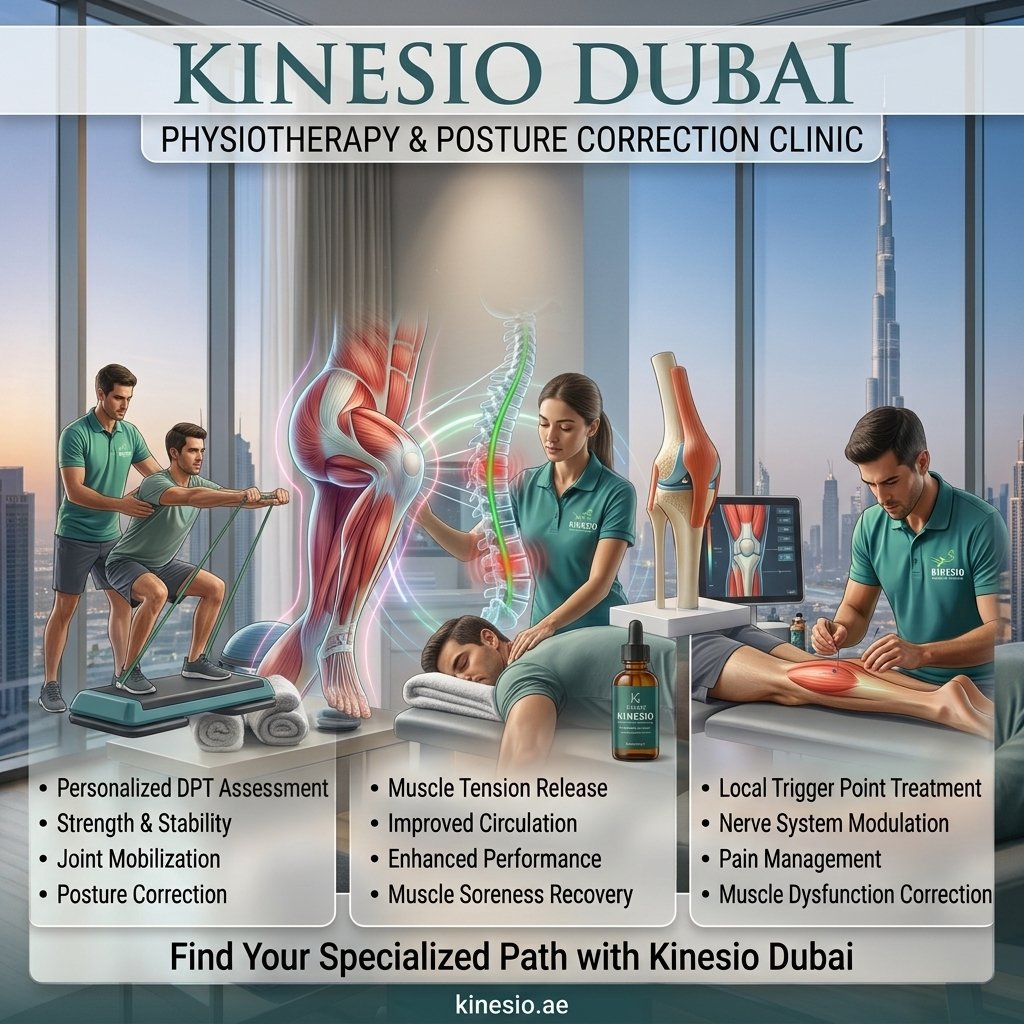
When you have muscle tightness, joint pain, a sports problem or an uncomfortable movement, it can be difficult to know which treatment to book.
Should you see a physiotherapist? Would a sports massage be enough? Is dry needling a better option for stubborn muscle tension?
The answer depends on what is causing your symptoms and what you are trying to achieve.
Physiotherapy, sports massage and dry needling are not identical treatments. They can have different purposes, and in some cases more than one approach may be used as part of a broader recovery plan.
For people searching for physiotherapy Dubai, sports massage Dubai or dry needling Dubai, understanding the difference can make the first appointment much more useful.
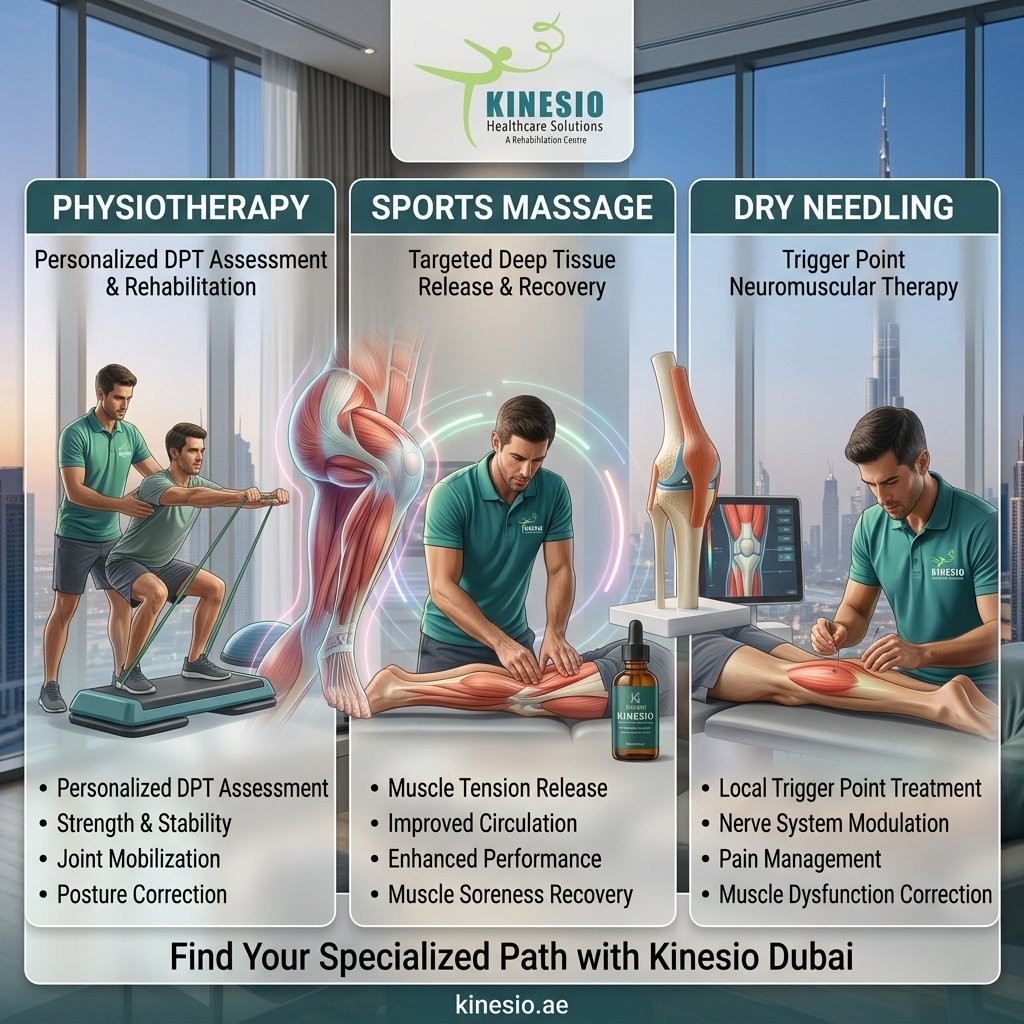
Physiotherapy vs Sports Massage vs Dry Needling
The simplest way to understand the three is to look at their primary role.
Physiotherapy is focused on assessment, rehabilitation, movement and physical function.
Sports massage focuses mainly on soft-tissue work, muscle tension, soreness and recovery.
Dry needling uses fine needles to target specific muscle areas, often including trigger points or areas of increased muscle tension.
These approaches can overlap, but they are not interchangeable.
Dubai healthcare providers currently describe physiotherapy as a broader clinical service involving assessment, rehabilitation and exercise, while sports massage is generally focused on soft tissue and recovery. Dry needling is commonly used as an adjunct technique within physiotherapy care.
What Is Orthopedic Physiotherapy?
Orthopedic physiotherapy focuses on musculoskeletal problems involving areas such as muscles, joints, tendons, ligaments and bones.
It may be appropriate when pain is affecting your movement or function, particularly following an injury or when symptoms continue to return.
A physiotherapist may assess:
- Joint movement
- Muscle strength
- Flexibility
- Balance
- Movement patterns
- Functional limitations
- Activity levels
- Previous injuries
Treatment can then be built around the findings.
At Kinesio Healthcare Solutions, musculoskeletal and orthopedic physiotherapy is positioned around personalised assessment and rehabilitation for problems affecting movement and physical function. The clinic also lists sports injury rehabilitation, sports massage and dry needling among its services.
What Does Sports Massage Do?
Sports massage is often chosen by active people who feel muscular tightness, soreness or fatigue.
Despite the name, you do not have to be a professional athlete to have a sports massage.
It may be relevant for:
- Gym-goers
- Runners
- Football players
- Tennis players
- Padel players
- Cyclists
- Recreational athletes
- People with physically demanding routines
The focus is generally on soft tissues and muscular comfort.
A sports massage can be useful when the main issue feels like muscle tightness or post-training soreness and there is no indication that you need a more comprehensive clinical assessment.
Kinesio’s sports massage service is designed around recovery, muscle tension and performance needs.
What Is Dry Needling?
Dry needling is a physiotherapy technique that uses thin needles to target selected muscles or soft-tissue areas.
It is commonly used when muscle tension, trigger points or restricted movement appear to be contributing to symptoms.
Some Dubai clinics currently describe dry needling as an adjunct treatment for stubborn muscle tightness, sports-related muscle problems and trigger points.
Kinesio Healthcare Solutions describes dry needling as part of its physiotherapy service and notes that the number of sessions depends on the individual’s condition and severity of muscle tension.
Dry needling is not the same as acupuncture, even though both use needles. Dry needling is generally based on musculoskeletal anatomy and is used as a treatment technique within rehabilitation.
When Is Physiotherapy More Appropriate?
You may want a physiotherapy assessment in Dubai when the problem goes beyond general muscle tightness.
Physiotherapy may be particularly relevant when:
- You have an injury
- Pain keeps returning
- A joint is painful or stiff
- Your movement is limited
- You have weakness
- You are struggling with daily activities
- You are recovering after surgery
- A sports injury is stopping you from training
- You are unsure what is causing the pain
For example, if your knee hurts every time you climb stairs, simply getting a massage may not tell you why the problem is happening.
A physiotherapy assessment can examine your strength, mobility and movement and determine what rehabilitation may be appropriate.
When Can Sports Massage Be Useful?
Sports massage may be worth considering when your main concern is:
- General muscle tightness
- Post-training soreness
- Physical fatigue
- Muscle tension
- Recovery between workouts
- Maintaining comfortable soft-tissue mobility
It can be especially useful for someone who trains regularly but is not dealing with a significant injury.
Sports massage is often used as part of a broader recovery routine rather than as a replacement for rehabilitation.
When Can Dry Needling Be Considered?
Dry needling may be considered when a physiotherapy assessment suggests that specific muscle tension or trigger points are contributing to your symptoms.
Examples may include:
- Persistent muscle knots
- Localised muscle tightness
- Some sports-related muscle problems
- Restricted movement associated with muscle tension
- Areas of muscle guarding
Current Dubai physiotherapy providers commonly position dry needling as an adjunct technique rather than a standalone answer for every pain problem.
Can Physiotherapy, Sports Massage and Dry Needling Be Combined?
Yes, they can sometimes be used together.
This is particularly relevant when a person has both a movement problem and significant muscle tightness.
For example, an athlete may have reduced movement, muscle tension and weakness after a period of intense training.
A treatment plan might include:
Orthopedic physiotherapy to assess the underlying movement or musculoskeletal problem.
Dry needling where appropriate to address specific muscle tension.
Sports massage as part of recovery and soft-tissue management.
Therapeutic exercise to improve strength, mobility and physical capacity.
This integrated approach is also reflected in current Dubai rehabilitation services, where manual treatment, exercise, dry needling and sports massage may be offered within the same broader rehabilitation setting.
Physiotherapy or Sports Massage for Sports Injuries?
This depends on whether you are dealing with normal muscular soreness or an actual injury.
After a demanding training session, your muscles may simply feel tired or tight. Sports massage may be appropriate for recovery.
But if you have:
- Sudden pain
- Swelling
- Loss of strength
- Reduced joint movement
- Pain after a specific injury
- Difficulty putting weight on an injured area
a clinical assessment is more appropriate.
A massage cannot determine every cause of sports injury or tell you whether an injured structure has regained enough strength for return to sport.
That is where sports injury physiotherapy and structured rehabilitation become important.
Dry Needling or Sports Massage for Muscle Knots?
This is a common question.
Both approaches may be used when muscle tension is part of the problem, but they are delivered differently.
Sports massage uses hands-on pressure and soft-tissue techniques.
Dry needling uses a fine needle to target selected areas of muscle.
The choice depends on the assessment, the location of the symptoms, your tolerance and the treatment goal.
It is not accurate to say that one is always better than the other. In some cases, either may be appropriate; in others, neither is the main treatment required.
What About Joint Pain?
This is where orthopedic physiotherapy becomes especially relevant.
If your main problem is knee, shoulder, hip, ankle or another joint pain, the first question should be why the joint is painful and what is limiting your function.
Massage may help surrounding muscle tension, and dry needling may be useful for selected muscular contributors.
But a joint problem may require a broader assessment of movement, strength, load and function.
Kinesio’s orthopedic physiotherapy service covers musculoskeletal problems and rehabilitation, making it the most relevant starting point when joint pain or movement limitation is the main concern.
What Treatment Is Best After a Workout?
There is no universal answer.
If you simply feel tired and tight after training, recovery-focused sports massage may be appropriate.
If you have a recurring muscle problem, dry needling may be considered as part of physiotherapy.
If you have pain, weakness or a movement problem that is affecting your training, a physiotherapy assessment may be more useful.
The key is to identify whether you are dealing with normal training fatigue, muscular tension or an actual musculoskeletal problem.
What About Chronic Muscle Tightness?
Repeatedly treating tightness without asking why it keeps coming back can miss an important part of the problem.
For example, the same calf may keep becoming tight because of training load, mobility limitations, weakness or another movement issue.
In such cases, massage or dry needling may provide short-term symptom relief, but the longer-term plan may also need strengthening, movement retraining or changes to training load.
This is where physiotherapy can connect the pieces.
How Do You Choose the Right Treatment?
A simple way to think about it is:
Mainly muscle soreness or general tightness: sports massage may be worth considering.
Specific stubborn muscle tension or trigger points: dry needling may be considered after assessment.
Pain, injury, weakness, joint problems or movement limitations: physiotherapy assessment is generally the more comprehensive starting point.
A combination of problems: a physiotherapist can determine whether several techniques should form part of one rehabilitation programme.
This approach avoids choosing a treatment simply because it is popular.
What Happens at Your First Kinesio Appointment?
The first step should be understanding the problem.
A physiotherapist may ask about your symptoms, exercise routine, previous injuries and daily activities.
They may then assess:
- Movement
- Strength
- Mobility
- Pain behaviour
- Functional limitations
- Relevant joints and muscles
From there, the treatment plan can be personalised.
Kinesio Healthcare Solutions describes its services as personalised and includes musculoskeletal and orthopedic physiotherapy, sports massage, dry needling, manual therapy and sports injury rehabilitation.
Sports Recovery in Dubai
Dubai has a large population of people who regularly train, run, play padel, tennis and football, or attend gyms.
For active people, recovery is not only about getting another massage.
A complete recovery plan may involve:
- Appropriate exercise
- Strength training
- Mobility
- Rest
- Training-load management
- Physiotherapy when needed
- Sports massage
- Selected treatment techniques such as dry needling
The right combination depends on the person rather than the name of the treatment.
When Should You Not Just Book a Massage?
Do not automatically choose massage when you have a new or severe injury.
Seek professional medical or physiotherapy assessment when there is significant swelling, major bruising, substantial weakness, inability to use the affected area normally, deformity or severe pain.
A persistent problem that keeps returning also deserves a proper assessment.
Frequently Asked Questions
Is physiotherapy better than sports massage?
They serve different purposes. Physiotherapy involves clinical assessment and rehabilitation, while sports massage focuses primarily on soft tissues, muscle tension and recovery.
Is dry needling better than massage?
Neither is universally better. Dry needling and massage work differently and may suit different presentations.
Can physiotherapy include dry needling?
Yes. Dry needling can be used as one technique within a broader physiotherapy and rehabilitation programme when appropriate.
Can I get a sports massage after an injury?
It depends on the injury and its stage. Strong massage may not be appropriate immediately after certain injuries, particularly where there is swelling or suspected tissue damage. Assessment should come first.
Is sports massage only for athletes?
No. Anyone experiencing muscular tightness or physical fatigue may seek sports massage, although treatment should match the individual’s needs.
How many dry needling sessions do I need?
There is no fixed number. Kinesio states that session requirements depend on the person’s condition and severity of muscle tension.
Can these treatments be used together?
They can sometimes be combined as part of an individualised rehabilitation or recovery plan, depending on the person’s symptoms and clinical assessment.
What should I book for knee or shoulder pain?
When joint pain, weakness or movement limitations are involved, a physiotherapy assessment is generally a more appropriate starting point than selecting a massage treatment based only on the location of pain.
Final Thoughts
Choosing between orthopedic physiotherapy, sports massage and dry needling does not have to be confusing.
The most important question is not which treatment is more popular. It is what is actually causing your symptoms and what does your body need to recover?
Sports massage can be useful for muscle tension and recovery. Dry needling can be considered for