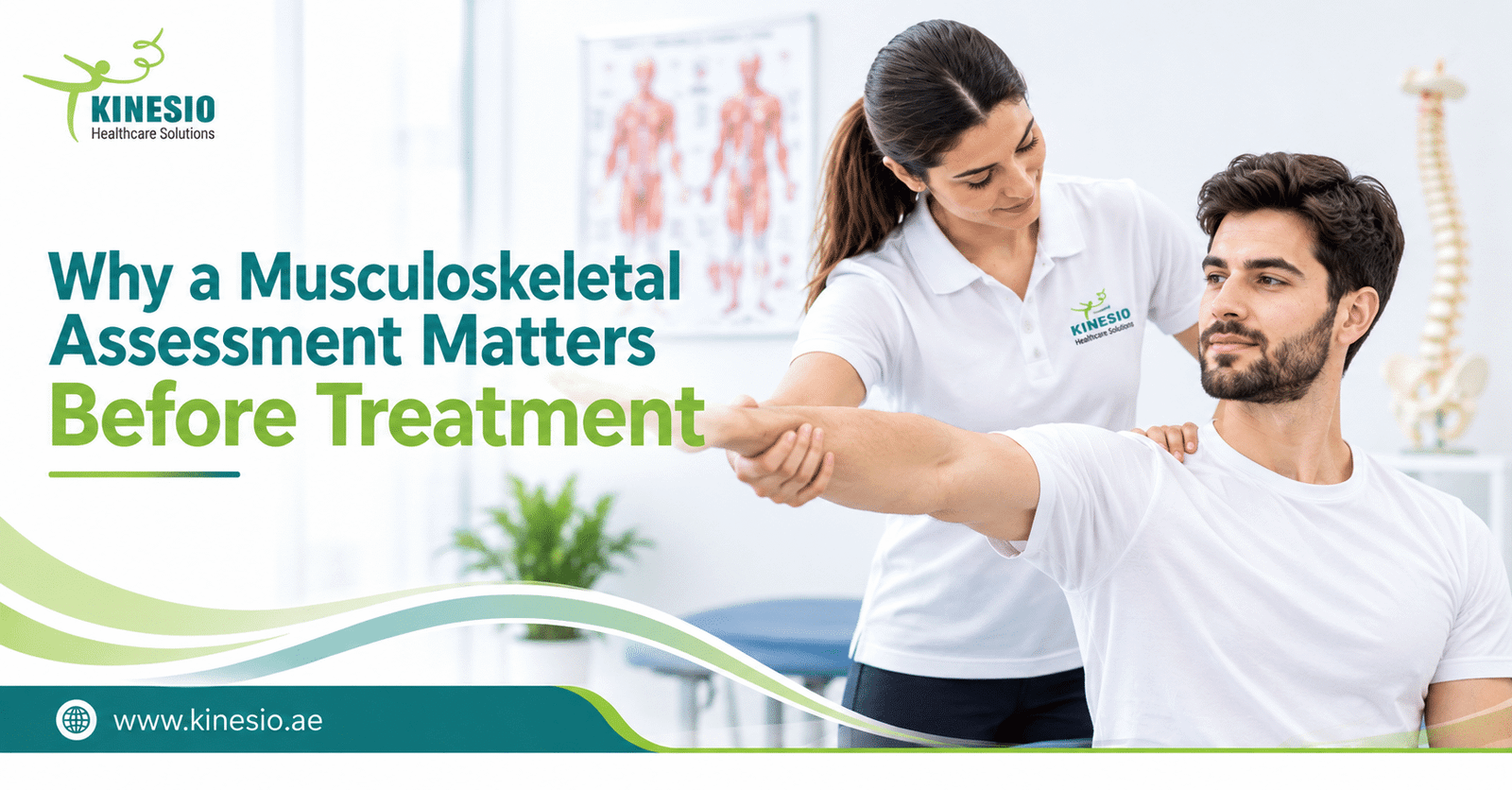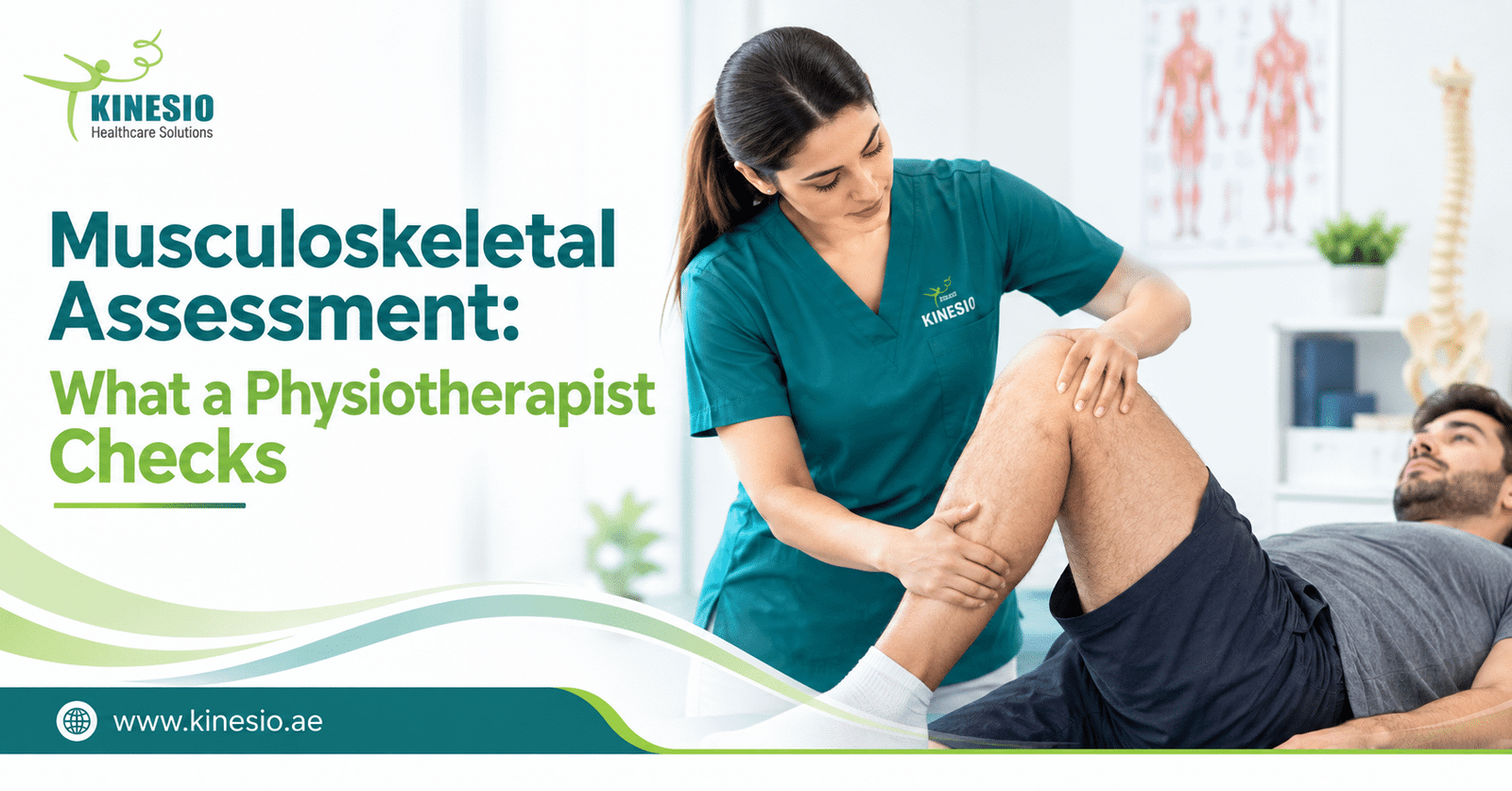
Back pain that won’t settle. A stiff shoulder after long hours at a desk. A knee that aches every time you run along the Marina. Most people want treatment straight away, but good physiotherapy starts with something more important: finding out why it hurts.
That’s the job of a musculoskeletal assessment Dubai. It’s a structured examination of your muscles, joints, bones, ligaments and nerves that helps your physiotherapist pinpoint the source of your symptoms and build a treatment plan that fits your body, your work and your goals.
This guide walks you through exactly what a physiotherapist checks, step by step, so you know what to expect at your first appointment.
What Is a Musculoskeletal Assessment?
A physiotherapy musculoskeletal assessment is a hands-on clinical evaluation of the locomotor system: the muscles, bones, joints and connective tissues that let you move. It combines a detailed conversation about your symptoms with physical tests such as movement assessment, strength assessment and mobility testing.
These problems are extremely common. The World Health Organization estimates that approximately 1.71 billion people worldwide live with musculoskeletal conditions, with low back pain the biggest contributor. They affect people of all ages, including younger adults in their working years.
The goal of the musculoskeletal assessment Dubai isn’t just to name a condition. It’s to understand what’s driving it, whether that’s weakness, stiffness, poor movement patterns, posture or overload, so treatment targets the cause rather than only the pain.
Who Should Book a Musculoskeletal Assessment Dubai?
You don’t need to wait for a serious injury. A musculoskeletal assessment Dubai is worth booking if you have:
- Back or neck pain lasting more than a week or two, or that keeps coming back
- Joint pain in the shoulder, hip, knee, ankle, elbow or wrist
- A sports injury such as a sprain, strain or tendon problem
- Stiffness or reduced range of movement
- Pain linked to desk work, driving or long-haul travel
- Recovery needs after surgery or a fracture
- Pins and needles, numbness or weakness in an arm or leg
- A goal to return to sport, train harder or prevent injury
For athletes and active people, our sport injuries and rehabilitation team uses the assessment to plan a safe return to play.
What a Physiotherapist Checks: Step by Step
Every physiotherapy musculoskeletal assessment follows a logical order. Your physiotherapist will adapt it to your problem, but most sessions cover these ten areas.
1. Your history and symptoms
The assessment starts with a conversation. This is often where the biggest clues come from. Your physiotherapist will ask:
- Where exactly is the pain, and does it spread anywhere?
- When did it start, and was there an injury or a gradual build-up?
- What makes it better or worse?
- How does it affect your sleep, work, training and daily life?
- Your medical history, previous injuries, surgeries and medications
- Your job, activity levels and personal goals
Many people also rate their pain on a 0–10 scale or complete a short questionnaire. This gives a baseline to measure progress against.
2. Screening for red flags
Before any physical testing, your physiotherapist checks for warning signs that need medical attention rather than physiotherapy. These include unexplained weight loss, fever, severe night pain, recent major trauma, or changes in bladder or bowel control. If anything concerning appears, you’ll be referred to a doctor promptly.
3. Posture and observation
Next, your physiotherapist looks at how you stand, sit and hold yourself. They’ll note:
- Alignment of the head, shoulders, spine, pelvis and knees
- Differences between the left and right sides
- Swelling, bruising or muscle wasting
- How you protect or guard the painful area
Posture alone rarely causes pain, but it can show habits and load patterns that contribute to it. Where this is a factor, postural education becomes part of your plan.
4. Movement assessment
A movement assessment shows how your body actually moves, not just how it looks at rest. You may be asked to:
- Bend forward, backward and to each side
- Squat, lunge or step up
- Balance on one leg
- Reach overhead or behind your back
- Walk, jog or perform a sport-specific movement
Your physiotherapist watches for compensations, such as a knee that collapses inward during a squat or a shoulder that hitches when you lift your arm. These patterns often explain why a problem keeps returning.
5. Mobility testing
Mobility testing measures how far and how freely your joints and soft tissues move. It usually includes:
- Active range of motion: how far you can move a joint yourself
- Passive range of motion: how far the physiotherapist can move it while you relax
- Joint accessory movements: small gliding movements inside the joint that reveal stiffness or excess laxity
- Muscle length and flexibility: for example, tight hamstrings, hip flexors or calves
- Nerve mobility: whether nerves glide freely or are sensitised
The difference between active and passive movement is especially useful. If you can’t lift your arm but your physiotherapist can, the problem may be weakness or pain inhibition rather than a stiff joint.
6. Strength assessment
A strength musculoskeletal assessment Dubai checks whether muscles can produce and control force. Methods include:
- Manual muscle testing against the physiotherapist’s resistance
- Comparing the injured side with the healthy side
- Endurance tests, such as how long you can hold a position
- Functional strength tests, such as single-leg squats or hops
- Hand-held dynamometry, where available, for precise measurements
Weakness in one area often overloads another. Weak hip muscles, for example, are a common contributor to knee pain in runners.
7. Neurological checks
If you have symptoms such as tingling, numbness, radiating pain or weakness, your physiotherapist will test the nervous system. This includes sensation, reflexes and muscle power in specific nerve patterns. It helps tell the difference between, for example, a local back problem and an irritated nerve root.
8. Palpation
Using their hands, your physiotherapist feels the tissues around the painful area. They’re checking for tenderness, muscle tension, trigger points, swelling, warmth and changes in tissue texture. Palpation helps confirm which structure is involved and can guide hands-on treatments such as manual therapy or dry needling.
9. Special tests
Special tests are specific movements or positions designed to stress a particular structure. Depending on your symptoms, these may test:
- Knee ligaments and meniscus
- Shoulder rotator cuff and impingement
- Lumbar discs and nerve tension
- Ankle stability after a sprain
- Sacroiliac joint involvement
No single test is definitive, so your physiotherapist combines the results with everything else they’ve found.
10. Functional and sport-specific testing
Finally, your physiotherapist checks how you perform the activities that matter to you. For an office worker, that might be sitting tolerance and lifting. For a padel player or runner, it might be jumping, landing, cutting or sprinting. These tests set clear, measurable goals for your rehabilitation.
What Happens After Your Assessment
Once the examination is complete, your physiotherapist explains what they’ve found in plain language. A good musculoskeletal assessment Dubai should leave you with:
- A clear explanation of the likely cause of your symptoms
- Measurable baselines for pain, movement, mobility and strength
- A personalised treatment plan with realistic timeframes
- Advice you can start using right away, such as activity changes or simple exercises
- A referral for imaging or a specialist opinion, if needed
Treatment often starts in the same session. Depending on what’s found, your plan may include:
| Assessment finding | Possible treatment |
|---|---|
| Stiff joints or limited range | Manual therapy, joint mobilisation, mobility exercises |
| Muscle weakness or poor control | Progressive strengthening and motor control training |
| Tight or tender muscles | Soft tissue work, sports massage, dry needling |
| Joint instability or swelling | Supportive Kinesio Taping, load management |
| Faulty movement patterns | Movement retraining and sport-specific drills |
| Desk-related pain | Ergonomic advice and postural education |
You’ll be reassessed regularly using the same tests, so you can see your progress in clear numbers rather than guesswork.
How to Prepare for a Musculoskeletal Assessment Dubai
A little preparation helps you get the most from your appointment:
- Wear comfortable clothing that lets the physiotherapist see and move the area, such as shorts for knee or hip problems, or a vest top for shoulder issues
- Bring reports and scans, including X-rays, MRI results or surgical notes
- List your medications and any medical conditions
- Note your symptoms over a few days: what triggers them and what eases them
- Think about your goals, whether that’s running a half marathon, playing with your kids or sitting through a workday pain-free
- Arrive a few minutes early to complete any forms
At Kinesio, a first musculoskeletal assessment Dubai usually lasts around 45 to 60 minutes, which includes the assessment and often some initial treatment.
Why Choose Kinesio for a Musculoskeletal Assessment Dubai?
At Kinesio, every plan starts with a thorough assessment. Our approach is:
- One-to-one and hands-on. You get your physiotherapist’s full attention for the whole session.
- Evidence-based. Treatment is built on current research and on your assessment findings, not a one-size-fits-all protocol.
- Personalised. Plans are tailored to your condition, lifestyle and goals.
- Comprehensive. From orthopaedic and musculoskeletal physiotherapy to geriatric physiotherapy and women’s health, we can treat a wide range of conditions under one roof.
Our clinic is in Dubai Media City, and we see clients from Dubai Marina, JLT, Al Barsha, Jumeirah, Business Bay and Downtown. Meet our physiotherapy team or read what our patients say.
All physiotherapists practising in Dubai must be licensed by the Dubai Health Authority, so always check your provider’s credentials.
Conclusion
A proper musculoskeletal assessment Dubai is the foundation of effective physiotherapy. By checking your history, posture, movement, mobility, strength, nerves and function, your physiotherapist can find the real cause of your pain and give you a clear, measurable path to recovery.
If pain or stiffness is holding you back, don’t just treat the symptoms. Book your musculoskeletal assessment Dubai with Kinesio and get a plan built around you.
Frequently Asked Questions
How long does a musculoskeletal assessment take?
An initial assessment usually takes 45 to 60 minutes. Follow-up sessions are shorter and include brief reassessments to track progress.
Do I need a doctor’s referral for a musculoskeletal assessment Dubai?
In most cases you can book a physiotherapy assessment directly. Some insurance policies require a doctor’s referral to cover the cost, so check with your insurer before your appointment.
Is a musculoskeletal assessment painful?
It shouldn’t be. Some tests may briefly reproduce your symptoms, because that helps identify the problem. Your physiotherapist will work within your comfort level and stop if anything feels too uncomfortable.
What’s the difference between a movement assessment and mobility testing?
A movement assessment looks at how you perform whole-body tasks such as squatting, walking or reaching. Mobility testing measures how far individual joints and soft tissues can move. Both are needed for a complete picture.
Will I need an X-ray or MRI?
Not always. Many musculoskeletal problems can be diagnosed through a clinical assessment alone. If your physiotherapist suspects something that needs imaging, such as a fracture or a significant tear, they will refer you.
Can a strength assessment help prevent injuries?
Yes. A strength assessment can reveal weaknesses or imbalances before they cause problems. That’s why many runners, gym-goers and padel players book a musculoskeletal assessment Dubai even when they’re pain-free.
What should I wear to my physiotherapy assessment?
Wear loose, comfortable clothing that allows access to the area being assessed. Shorts and a T-shirt or vest top work well for most problems.