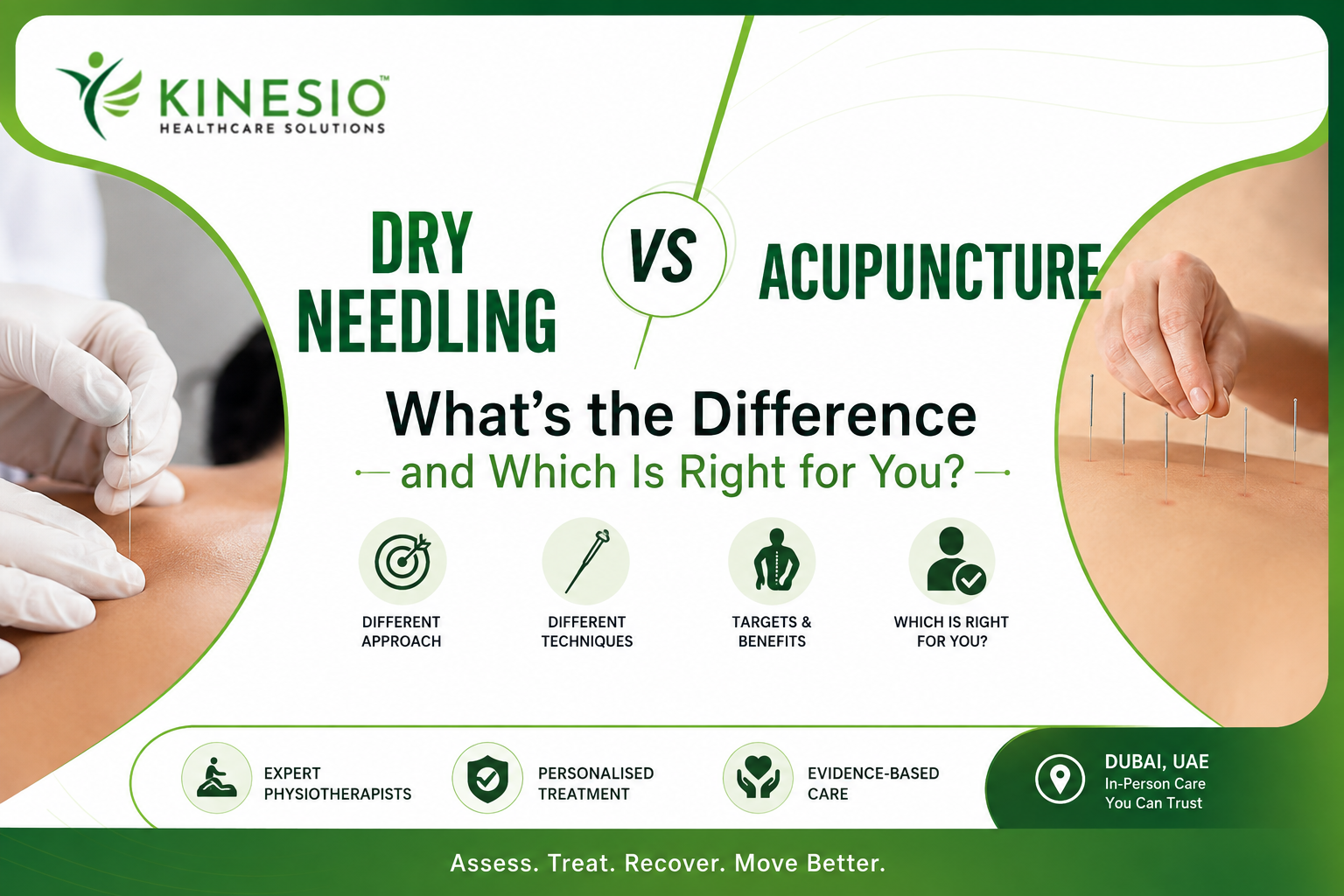
Dry Needling vs Acupuncture: What’s the Difference?
If you’re dealing with persistent muscle tightness, trigger points, back pain or certain sports-related injuries, you may have come across dry needling and acupuncture.
Both treatments use thin needles, so it is easy to assume they are basically the same thing. They aren’t.
While there can be similarities in the equipment used, dry needling and acupuncture differ in their underlying approaches, treatment goals and how practitioners determine where needles are placed.
So, which one should you choose?
The answer depends on what you are trying to treat, your symptoms, your medical history and the assessment performed by a qualified healthcare professional.
For people in Dubai considering dry needling, understanding the difference can make it much easier to have an informed conversation with a physiotherapist about whether the treatment is appropriate for them.
Quick Answer: Dry Needling vs Acupuncture
Dry needling is commonly used within musculoskeletal physiotherapy to address problems such as muscle tightness and myofascial trigger points. A physiotherapist may use a fine needle to target specific tissues as part of a broader rehabilitation programme.
Acupuncture is a treatment based on traditional acupuncture systems, in which needles are inserted at specific points according to the practitioner’s assessment and treatment approach.
In simple terms:
Dry needling generally focuses on musculoskeletal problems and targeted tissues, while acupuncture follows an acupuncture-based diagnostic and treatment framework.
Neither treatment is automatically “better.” The appropriate option depends on the individual and the problem being treated.
What Is Dry Needling?
Dry needling is a technique used by appropriately trained healthcare professionals, including physiotherapists in applicable settings, as part of treatment for certain musculoskeletal conditions.
A practitioner may identify areas of muscle tension or myofascial trigger points during an assessment and use a sterile, fine needle to stimulate the targeted tissue.
The objective may include helping manage pain, reducing muscle-related symptoms or improving movement as part of a wider rehabilitation plan.
Dry needling isn’t normally considered a standalone solution for every type of pain.
A good physiotherapy programme may combine it with:
- Exercise therapy
- Manual therapy
- Mobility work
- Strengthening
- Movement retraining
- Education about injury management
- Activity modification
The exact approach should be based on an individual’s assessment.
What Is Acupuncture?
Acupuncture is a therapeutic practice involving the insertion of fine needles into specific points on the body.
Traditional acupuncture has its own diagnostic and treatment framework. Modern clinical acupuncture may also be discussed in the context of pain management and other health conditions.
The important point is that acupuncture is not simply another name for dry needling.
Although both use needles, the reasoning behind treatment and the way practitioners select treatment points can be different.
Dry Needling vs Acupuncture: Key Differences
The easiest way to understand the difference is to look at the treatment approach.
| Dry Needling | Acupuncture |
|---|---|
| Commonly used in musculoskeletal rehabilitation | Based on acupuncture treatment systems |
| Often targets muscles and myofascial trigger points | Uses specific acupuncture points |
| Frequently incorporated into physiotherapy | Usually provided as an acupuncture treatment |
| May be used alongside exercise and rehabilitation | Treatment approach depends on the practitioner’s acupuncture assessment |
| Often considered for muscle-related pain and movement problems | Commonly sought for pain management and other therapeutic purposes |
There can be overlap in how needles are physically used, but the clinical framework behind the treatment is different.
Dry Needling vs Acupuncture: Which Hurts More?
This is one of the most common questions people ask.
The honest answer is: there isn’t one treatment that universally hurts more.
Your experience can depend on:
- Where the needle is inserted
- The condition being treated
- Muscle sensitivity
- Individual pain tolerance
- Needle technique
- The number of needles used
- Whether a sensitive or irritated area is being treated
During dry needling, some people experience a brief twitch, cramp-like sensation or local discomfort when a targeted muscle responds.
Acupuncture may feel like a small prick, pressure, heaviness or other sensation depending on the technique and treatment point.
If you’re nervous about needles, tell your practitioner before treatment. A good practitioner can explain what you are likely to feel and answer questions before beginning.
Dry Needling vs Acupuncture: Needle Size
Both techniques generally use fine needles, rather than the large needles people may associate with injections.
However, needle length and selection can vary depending on:
- Treatment location
- Patient anatomy
- Target tissue
- Practitioner technique
- Treatment objective
Therefore, there isn’t one universal “dry needling needle size” or one acupuncture needle size that applies to every treatment.
The more useful question is whether the practitioner is using an appropriate sterile needle and technique for the specific treatment area.
Dry Needling vs Acupuncture: How Deep Are the Needles?
Another common search is “dry needling vs acupuncture depth.”
The depth isn’t necessarily the same in every treatment.
For dry needling, the practitioner considers the anatomy of the area being treated and the intended target tissue. Depending on the muscle and treatment technique, the needle may be inserted to different depths.
Acupuncture needle depth also varies according to the treatment point, body area and clinical approach.
Because anatomy differs considerably from one part of the body to another, needle depth should always be determined by a properly trained practitioner rather than by a fixed number.
Dry Needling vs Acupuncture for Back Pain
Both dry needling and acupuncture may be considered by people experiencing back pain, but they aren’t interchangeable treatments.
For example, a person with back pain associated with muscle tension may benefit from an assessment focused on:
- Muscle function
- Joint mobility
- Strength
- Movement patterns
- Previous injuries
- Daily activities
- Work or sports demands
If dry needling is considered appropriate, it may be incorporated into a broader physiotherapy programme.
The important point is that back pain has many possible causes. A needle-based treatment should not replace a proper assessment.
If back pain is severe, persistent, worsening or accompanied by concerning symptoms, medical assessment may be appropriate.
Dry Needling vs Acupuncture for Sciatica
Sciatica is another condition where people often search for the difference between these treatments.
Sciatica generally involves symptoms associated with irritation or compression affecting the sciatic nerve and can cause pain, tingling, numbness or weakness along the lower back and leg.
Because the causes of sciatic symptoms can vary, treatment should start with an appropriate assessment.
Dry needling may sometimes be considered when muscular factors are contributing to a person’s symptoms, but it isn’t a universal treatment for sciatica.
Similarly, acupuncture may be considered by some people for symptom management, but the appropriate treatment depends on the underlying problem.
The goal should be to understand why the symptoms are occurring rather than simply choosing a treatment because it uses needles.
Can Dry Needling Help Muscle Pain?
Dry needling is particularly relevant to musculoskeletal physiotherapy because practitioners may use it when muscle-related factors are contributing to pain or restricted movement.
It may be considered alongside other treatments for problems involving:
- Muscle tightness
- Myofascial trigger points
- Sports-related muscle problems
- Restricted movement
- Certain musculoskeletal pain conditions
However, results can vary between individuals.
For long-term recovery, addressing the underlying movement, strength or activity-related factors can be just as important as short-term symptom management.
Dry Needling for Sports Injuries
Athletes and active individuals sometimes seek dry needling as part of sports injury rehabilitation.
A physiotherapist may assess:
- What caused the injury
- Which tissues are involved
- Current pain and mobility
- Muscle strength
- Movement patterns
- Training or activity demands
- Readiness to return to sport
If appropriate, dry needling can potentially be incorporated into the rehabilitation process.
But it shouldn’t be viewed as a shortcut around rehabilitation.
Strength, mobility, load management and progressive return to activity remain important parts of recovery.
Is Dry Needling Safe?
When performed by an appropriately trained and qualified practitioner using appropriate infection-control procedures, dry needling can be used as part of clinical care.
However, like any procedure involving needles, it isn’t completely risk-free.
Possible short-term effects can include:
- Temporary soreness
- Minor bleeding
- Bruising
- Brief discomfort
- Temporary fatigue or other local reactions
More serious complications are uncommon but can occur, particularly if needling is performed incorrectly or in inappropriate areas.
This is why choosing a properly qualified practitioner is important.
Before treatment, tell your healthcare professional about relevant medical circumstances, medications and any concerns you have.
Who Should Consider Dry Needling in Dubai?
Dry needling may be worth discussing with a qualified physiotherapist if you are experiencing a musculoskeletal problem such as:
- Persistent muscle tightness
- Sports-related muscle problems
- Certain types of back pain
- Movement restrictions
- Myofascial trigger-point-related symptoms
- Muscle-related discomfort during rehabilitation
However, not everyone needs dry needling.
The right starting point is a professional assessment to determine what is causing the problem and whether dry needling has a place in the treatment plan.
Choosing a Dry Needling Clinic in Dubai
If you’re searching for dry needling in Dubai, don’t choose a clinic simply because it appears at the top of Google.
Look for a provider that can explain:
1. Who will perform the treatment?
Ask about the practitioner’s professional qualifications, training and experience.
2. Will you receive an assessment first?
Dry needling should be based on an appropriate clinical assessment rather than simply inserting needles into painful areas.
3. Is rehabilitation included?
For many musculoskeletal problems, the best approach involves more than passive treatment.
4. Will the practitioner explain the procedure?
You should understand what the treatment involves, what you may feel and what the potential risks are.
5. Is the treatment personalised?
Your treatment should reflect your symptoms, goals, physical condition and assessment findings.
Dry Needling vs Acupuncture: Which One Should You Choose?
There isn’t a universal answer.
Consider dry needling when your problem is primarily musculoskeletal and a qualified physiotherapist determines that targeted needling could complement your rehabilitation.
Consider acupuncture when you are specifically looking for acupuncture-based care from an appropriately qualified practitioner.
Most importantly, don’t select a treatment solely because someone online says it is “better.”
A proper assessment is a much better starting point.
Why Choose Kinesio for Physiotherapy in Dubai?
At Kinesio Healthcare Solutions, treatment can be approached from a rehabilitation perspective rather than focusing on a single technique.
If you’re considering dry needling, the first step is understanding your symptoms and identifying the factors that may be contributing to your problem.
Depending on your assessment, your physiotherapy programme may incorporate appropriate techniques alongside exercises, mobility work and rehabilitation.
This approach can be particularly relevant for people dealing with sports injuries, musculoskeletal problems, mobility limitations and muscle-related pain.
If you’re specifically searching for dry needling treatment in Dubai, Kinesio can help you understand whether it is appropriate for your particular situation.
Book an assessment with Kinesio Healthcare Solutions in Dubai to discuss your symptoms and treatment options.
Frequently Asked Questions
Is dry needling the same as acupuncture?
No. Although both treatments use fine needles, they are based on different treatment frameworks. Dry needling is commonly used within musculoskeletal physiotherapy, while acupuncture follows an acupuncture-based diagnostic and treatment approach.
Is dry needling more painful than acupuncture?
Not necessarily. Sensation varies between people and depends on the treatment area, technique and individual sensitivity.
What is the difference between dry needling and acupuncture?
Dry needling generally focuses on targeted musculoskeletal tissues, such as muscles and myofascial trigger points. Acupuncture uses specific acupuncture points within an acupuncture treatment framework.
Can dry needling help back pain?
It may be useful for some people with muscle-related components of back pain, but back pain has many causes. A proper assessment is important before deciding whether dry needling is appropriate.
Can dry needling help sciatica?
It may sometimes be used when muscular factors contribute to symptoms, but it isn’t a universal treatment for sciatica. The underlying cause of the symptoms should be assessed.
How deep does dry needling go?
Needle depth varies according to the treatment area, anatomy, target tissue and technique. There isn’t one standard depth for every treatment.
Are dry needling needles bigger than acupuncture needles?
Both generally use fine needles, but needle specifications can vary according to the treatment, location and practitioner.
How long does a dry needling session take?
The time varies depending on the assessment, treatment area and overall physiotherapy programme. Your practitioner can explain the expected appointment duration before treatment.
Can athletes use dry needling?
Dry needling may be incorporated into rehabilitation for certain sports-related conditions when a qualified practitioner considers it appropriate.
Can I have dry needling without physiotherapy?
Dry needling is often used as part of a broader musculoskeletal treatment programme. Whether it is appropriate as part of your care should be determined by a qualified practitioner after assessment.
Is dry needling safe?
It can be safely performed when appropriate by a properly trained practitioner using suitable procedures, but it does carry potential risks such as soreness, bruising and minor bleeding.
Should I choose dry needling or acupuncture?
It depends on your condition, goals and the treatment approach you prefer. A qualified practitioner can help determine which option is appropriate.
Key Takeaway
Dry needling and acupuncture are not the same treatment.
Although both use fine needles, they differ in their underlying approaches and treatment objectives. Dry needling is commonly associated with musculoskeletal physiotherapy and may target muscles or myofascial trigger points, while acupuncture follows its own treatment framework.
If you’re considering dry needling in Dubai, the best first step is a professional assessment rather than choosing a treatment based solely on online comparisons.
For people with muscle-related pain, sports injuries or movement problems, Kinesio Healthcare Solutions can assess your condition and discuss whether dry needling or another physiotherapy approach is appropriate.
Medically Reviewed Content
This article provides general educational information about physiotherapy, orthopedic rehabilitation, and musculoskeletal health. It is intended to support patient awareness and should not replace a professional assessment, diagnosis, or individualized treatment plan. Treatment recommendations should be based on each patient’s clinical presentation and needs.
Author: Kinesio Healthcare Solutions Editorial Team