Choosing an orthopedic physiotherapy clinic in Dubai is an important decision when pain, stiffness, an injury or reduced mobility starts affecting your daily life. The right clinic should do more than offer treatment for a painful area. It should assess your condition, understand your goals, explain your options and develop a rehabilitation plan that suits your needs.
Whether you are recovering from a sports injury, managing joint pain, preparing to return to exercise or looking for rehabilitation after surgery, it helps to know what to look for before booking an appointment.
A good starting point is to check five things: the physiotherapist’s credentials, the quality of the initial assessment, the relevance of their experience, the rehabilitation approach and how progress will be measured.
For people comparing a physiotherapy clinic in Dubai, these details are often more useful than choosing a provider based only on advertising claims, a long list of treatments or the lowest advertised price.

What Does an Orthopedic Physiotherapy Clinic Treat?
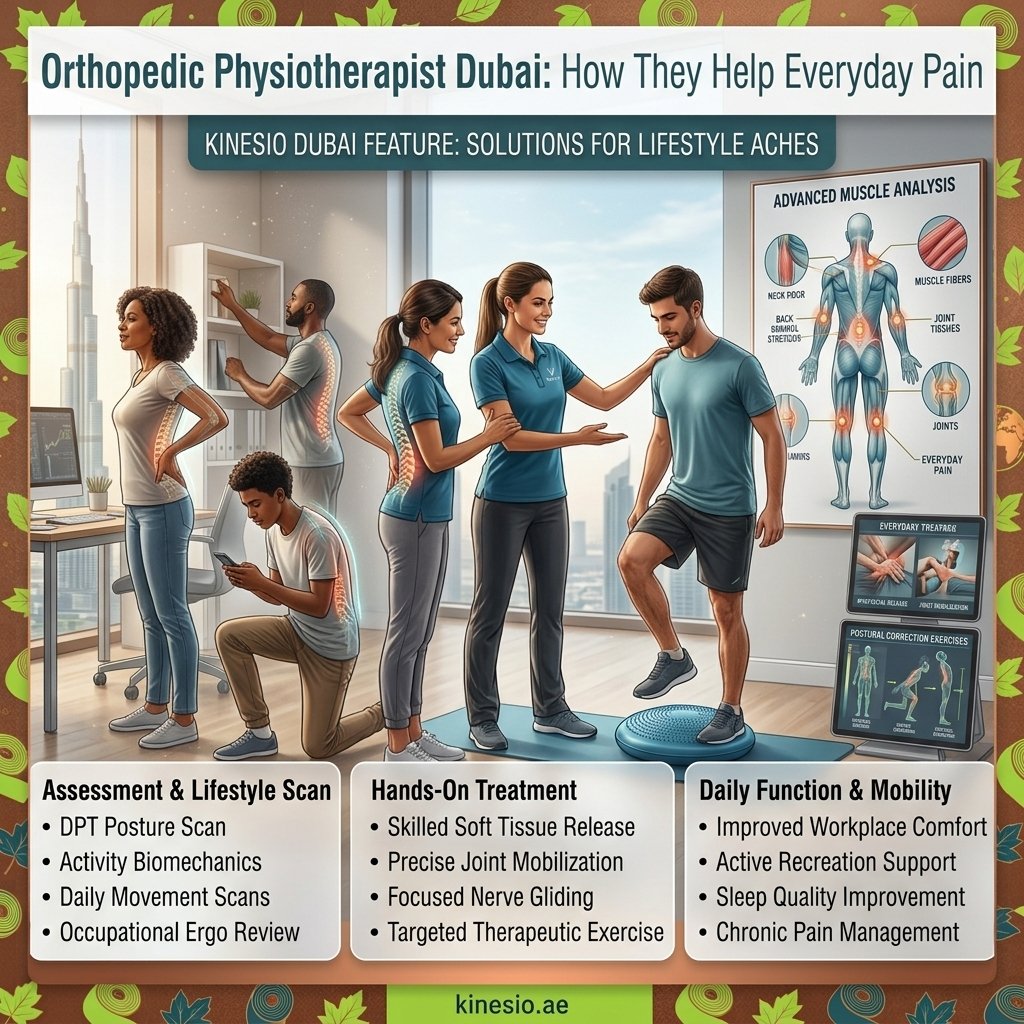
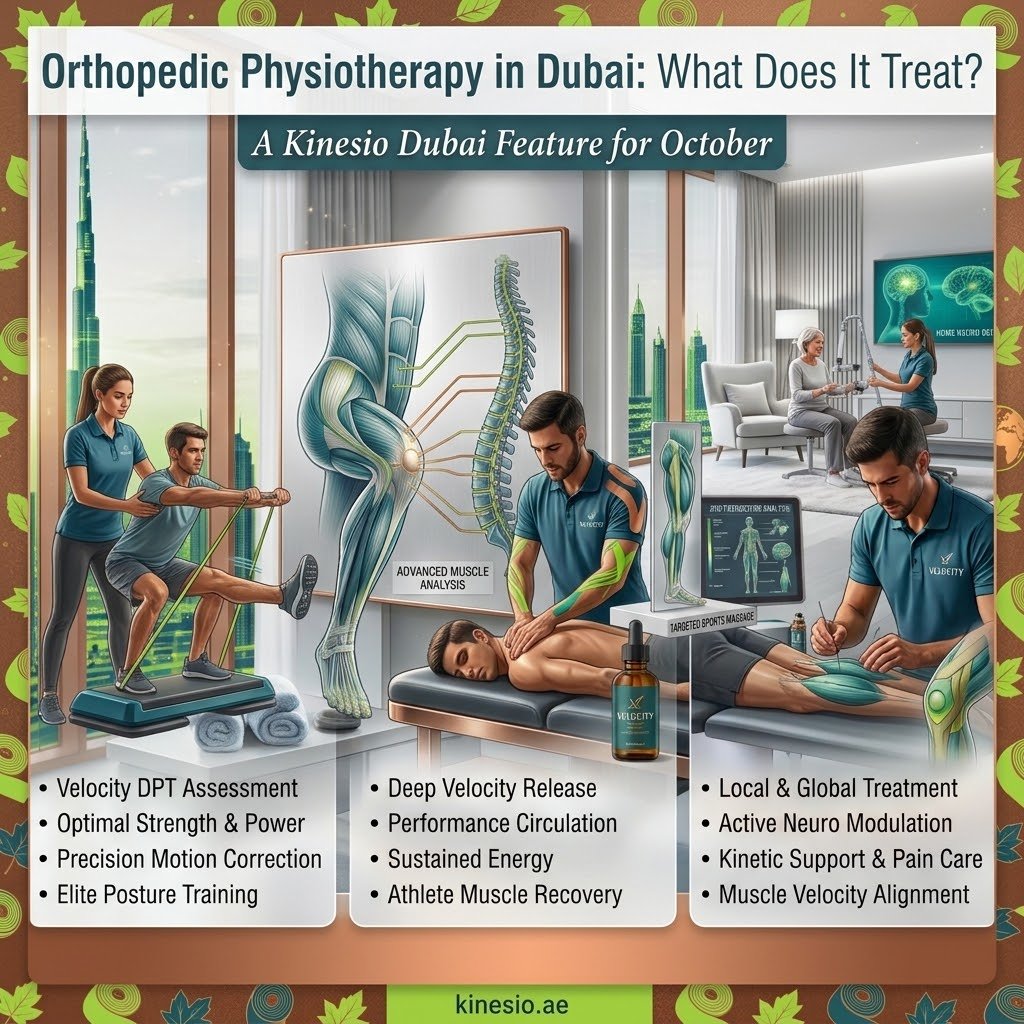
Orthopedic physiotherapy focuses on conditions affecting the musculoskeletal system, including the muscles, bones, joints, tendons and ligaments. Treatment may help people recover from injuries, improve movement, rebuild strength and return to normal activities.
An orthopedic rehabilitation clinic may work with people experiencing:
- Joint pain and stiffness
- Muscle strains and weakness
- Sports injuries
- Tendon and ligament problems
- Overuse injuries
- Mobility limitations
- Recovery after orthopedic surgery
- Fracture rehabilitation following appropriate medical treatment
- Some arthritis-related functional problems
- Difficulty returning to work, exercise or sport
The appropriate treatment depends on the underlying condition. Two people with knee pain, for example, may require different rehabilitation plans because their symptoms, medical histories and physical abilities are different.
Kinesio Healthcare Solutions provides musculoskeletal and orthopedic physiotherapy for conditions including sports injuries, overuse injuries, spinal conditions, joint pain, muscle weakness and post-surgical rehabilitation. Its service approach includes individual assessment and treatment planning.
For more information, see the Musculoskeletal & Orthopedic Physiotherapy service.
1. Check the Physiotherapist’s Credentials
One of the first things to consider when choosing an orthopedic physiotherapist in Dubai is professional registration and licensing.
Healthcare professionals practising in Dubai are subject to applicable professional licensing requirements. The Dubai Health Authority provides the Dubai Medical Registry, where users can search for healthcare facilities and professionals.
Before booking, consider asking:
- What are the physiotherapist’s qualifications?
- Are they appropriately licensed to practise in Dubai?
- Do they have experience with my type of condition?
- Do they regularly manage problems similar to mine?
- Will they explain my assessment findings and treatment options?
You can also use the DHA’s professional licence verification service to check professional registration or licensing information where the relevant details are available.
Credentials are an important starting point, but they are not the only consideration. Communication, clinical assessment, treatment planning and the ability to adapt rehabilitation to individual needs all matter.
2. Look for a Proper Initial Assessment
A physiotherapy appointment should begin with understanding the problem, not automatically applying the same treatment to every patient.
During an initial assessment, the physiotherapist may ask about your symptoms, previous injuries, medical history, activity levels and daily routine.
They may also examine movement, strength, flexibility, balance and the activities that are difficult for you.
For example, consider someone who experiences knee pain while climbing stairs. The assessment might examine knee movement, leg strength, balance and the way the person controls the movement. The goal is to understand the relevant factors rather than assume that every painful knee has the same cause.
Similarly, a person recovering from a shoulder injury may need a different assessment from someone who has developed shoulder stiffness after surgery.
A useful assessment should help answer three questions:
What might be contributing to the problem?
Which activities or movements are currently limited?
What are the appropriate next steps?
The NHS physiotherapy guide explains that physiotherapy appointments can involve discussing symptoms and medical history and assessing areas such as strength and balance.
A clinic that takes time to understand your condition gives you a clearer basis for discussing suitable treatment options.
3. Choose a Musculoskeletal Clinic in Dubai That Understands Your Condition
Not every patient needs the same type of physiotherapy.
Someone recovering after a knee operation may need a structured post-surgical programme. A recreational athlete with an ankle sprain may need balance and strength training. An office worker with recurring movement-related discomfort may need a different approach.
When comparing a musculoskeletal clinic Dubai, look at whether the clinic offers care relevant to your specific problem.
You can ask about experience with:
- Joint and muscle conditions
- Sports injuries
- Tendon and ligament problems
- Recovery after surgery
- Persistent musculoskeletal pain
- Functional and mobility limitations
You do not need to know your exact diagnosis before making an appointment. One purpose of the assessment is to understand the problem and determine whether the clinic can help or whether referral to another healthcare professional is appropriate.
The important point is to choose a service based on your needs rather than selecting a treatment simply because it is popular.
4. Understand What the Rehabilitation Plan Includes
A treatment plan should explain what you will be working toward and how the clinic intends to help you progress.
Depending on your condition, orthopedic physiotherapy may include:
Therapeutic exercise: Exercises designed to improve strength, mobility, balance or physical function.
Movement training: Practice of activities that are difficult, such as walking, stepping, lifting or returning to sport.
Manual therapy: Hands-on techniques that may be appropriate for selected conditions.
Education: Understanding your symptoms, managing activity and making informed decisions about recovery.
Home exercises: A suitable programme that helps you continue rehabilitation between appointments.
Progress monitoring: Reviewing how symptoms, movement and physical abilities change over time.
The right combination depends on the assessment. A treatment plan should not rely on a single technique regardless of what the patient needs.
For example, manual therapy may be useful for some musculoskeletal problems, but restoring strength and returning to daily activities may require active exercise as well.
NICE guidance for osteoarthritis recommends therapeutic exercise tailored to the individual’s needs, including local muscle strengthening and general aerobic fitness. It also advises that exercise should be continued consistently to gain longer-term benefits. See the NICE osteoarthritis recommendations.
This is one reason to ask how a clinic measures progress rather than judging a treatment only by how you feel immediately after a session.
5. Ask How Progress Will Be Measured
A useful rehabilitation programme has goals.
Those goals should reflect what matters in your everyday life.
For one person, progress might mean walking for longer without needing frequent breaks. For another, it could mean climbing stairs more comfortably, lifting objects at work or returning to the gym.
Someone recovering from a sports injury may need to regain strength, balance and the ability to perform sport-specific movements.
Before beginning treatment, ask how your progress will be reviewed.
Depending on your condition, this could involve changes in:
- Range of motion
- Strength
- Balance
- Walking ability
- Functional movements
- Exercise tolerance
- Confidence with activity
- Ability to perform daily tasks
Progress does not always happen in a straight line. Symptoms can fluctuate, and the appropriate recovery timeline varies between individuals.
The important thing is that the physiotherapist can explain what is being assessed and how the plan may change as your condition improves.
6. Consider the Clinic’s Approach to Joint Rehabilitation
Joint rehabilitation is not just about the joint itself.
The surrounding muscles, movement patterns and demands of daily activities can influence how a person moves and what they can comfortably do.
For example, someone recovering from a knee injury may need to rebuild leg strength and balance before returning to demanding exercise.
A person with shoulder stiffness may need to regain comfortable movement before progressing to more challenging strengthening exercises.
A patient recovering from joint surgery may require a programme that follows specific medical instructions and progresses according to the stage of recovery.
An appropriate joint rehabilitation plan should therefore consider:
- The underlying condition
- Current symptoms
- Medical or surgical instructions
- Range of motion
- Muscle strength
- Everyday functional demands
- Return-to-activity goals
The programme should also be reviewed when your circumstances or abilities change.
If your main goal is to return to a particular activity, mention that when you book. It can help the physiotherapist understand what successful rehabilitation needs to achieve.
7. Look Beyond the List of Treatments
Many clinics advertise several treatment techniques. That can be useful, but the number of services offered does not automatically tell you whether the clinic is suitable for your condition.
Instead, ask why a particular treatment is being recommended and how it fits into the overall plan.
For example, manual therapy might be included to support movement or symptom management. Exercise may be needed to build strength. Other techniques may be considered when there is a clear reason to use them.
You should be able to understand:
- What the treatment is intended to achieve
- Why it may suit your condition
- What alternatives are available
- Whether exercises or home activities are needed
- How the treatment will be reviewed
Clear communication allows you to take part in decisions about your care.
NICE guidance on shared decision-making recommends discussing the aims, possible benefits and risks of treatment options in relation to the person’s priorities and preferences. See the NICE shared decision-making recommendations.
8. Compare Physiotherapy Costs Carefully
Cost is a practical concern when choosing a physiotherapy clinic Dubai.
There is no single price that applies to every clinic or every type of appointment. Fees may vary according to the assessment required, session duration, clinician, treatment type and complexity of the rehabilitation programme.
Before booking, ask the clinic to explain its current fees and what is included.
Useful questions include:
- What is the price of the first assessment?
- How long is a standard appointment?
- Are follow-up sessions priced differently?
- Does the clinic offer packages?
- Are there cancellation or rescheduling charges?
- Is my insurance accepted?
- Do I need insurer approval or a referral?
- Will the treatment plan and likely costs be discussed before proceeding?
It is reasonable to compare prices, but the lowest advertised rate is not always the best value for your needs.
Consider whether the appointment includes an appropriate assessment, an explanation of the plan and advice about what happens between visits.
You should not feel pressured to commit to a large package before you understand your condition and the proposed treatment.
9. Location and Appointment Convenience Matter
Even a suitable clinic may be difficult to attend if getting there is inconvenient.
When comparing an orthopedic rehabilitation clinic in Dubai, consider the route from your home or workplace, appointment availability, parking or public transport access and whether the clinic’s hours suit your routine.
Convenience becomes particularly important when a rehabilitation programme involves repeated appointments.
However, proximity should not be the only deciding factor. A clinic should also provide relevant care and a treatment approach that matches your needs.
Kinesio Healthcare Solutions is located at Arjaan by Rotana, King Salman Bin Abdulaziz Al Saud Street, Al Sufouh 2, Dubai Media City. You can confirm current contact details and clinic hours on the Kinesio contact page.
If you work or live near Dubai Media City, Al Sufouh or surrounding areas, checking the route and appointment availability before booking can make planning easier.
10. Evaluate Communication and Patient Support
Good communication is an important part of physiotherapy.
You should be able to explain your concerns, ask questions and understand what the physiotherapist recommends.
A supportive clinic should help you understand your condition without making unrealistic promises.
Be cautious of claims that guarantee a complete recovery within a fixed number of sessions before the clinician has assessed you. Recovery depends on the condition, its severity, individual circumstances and response to treatment.
It is also reasonable to ask what you should do if symptoms worsen, what activities you can continue and when your treatment plan will be reviewed.
The aim is to help you participate in your recovery with a clear understanding of the next steps.
11. How to Compare Orthopedic Physiotherapy Clinics
If you are considering several providers, use a simple comparison checklist rather than relying on advertising claims alone.
| What to check | Questions to ask |
|---|---|
| Professional credentials | Is the physiotherapist appropriately licensed? |
| Relevant experience | Does the clinic treat my type of condition? |
| Initial assessment | Will my history, symptoms and movement be assessed? |
| Treatment plan | Will the plan be explained and tailored to my needs? |
| Active rehabilitation | Are exercises included when appropriate? |
| Progress tracking | How will improvements be measured? |
| Cost | What is included in the appointment fee? |
| Insurance | Are approvals or referrals required? |
| Convenience | Is the location and appointment schedule practical? |
| Communication | Can I ask questions and understand my options? |
This checklist does not rank individual clinics. It gives you a practical way to compare the information that matters before making an appointment.
12. Choosing an Orthopedic Physiotherapy Clinic in Dubai: A Practical Example
Imagine you have had knee pain for several weeks.
You have started avoiding stairs and stopped going to the gym because squatting feels uncomfortable.
You search for an orthopedic physiotherapy clinic in Dubai and find several options.
Rather than choosing solely on price, you contact two clinics and ask about their assessment process.
One explains that the initial visit includes a discussion of your symptoms, movement assessment, goal setting and a proposed plan. The other focuses mainly on selling a predefined treatment package before assessing you.
In this example, the first approach gives you more information to make an informed decision. It allows you to discuss your concerns, understand the likely next steps and ask questions before committing to treatment.
This is an illustrative scenario, not a comparison of actual clinics. The lesson is simple: choose a provider that helps you understand your condition and the proposed rehabilitation process.
13. Why Kinesio Healthcare Solutions May Be Relevant
Kinesio Healthcare Solutions provides musculoskeletal and orthopedic physiotherapy in Dubai for people dealing with joint pain, sports injuries, overuse problems, spinal conditions, muscle weakness and post-surgical rehabilitation.
The clinic describes its approach as personalised, with the initial assessment used to understand the person’s concerns, goals and lifestyle before creating a treatment plan.
Its orthopedic service also includes manual therapy and specialised exercises, with the aim of supporting movement, strength and function.
If you are comparing a musculoskeletal clinic Dubai for an orthopedic problem, you can review the service details here:
Musculoskeletal & Orthopedic Physiotherapy at Kinesio Healthcare Solutions
For background about the clinic, its approach and wider rehabilitation services, visit the About Kinesio Healthcare Solutions page.
The appropriate starting point depends on your symptoms. If you are unsure whether the clinic’s services match your condition, contact the team and explain what is happening before booking.
Frequently Asked Questions
What should I look for in an orthopedic physiotherapy clinic in Dubai?
Look for an appropriately licensed physiotherapist, a proper initial assessment, experience relevant to your condition, an individualised rehabilitation plan, clear communication and a way to monitor progress.
What is the difference between orthopedic and musculoskeletal physiotherapy?
The terms overlap. Both commonly refer to physiotherapy for conditions affecting muscles, joints, bones, tendons and ligaments. The exact service name may differ between clinics.
How can I verify a physiotherapist’s licence in Dubai?
You can use the Dubai Health Authority’s professional licence verification service and consult the Dubai Medical Registry for available professional and facility information.
What happens during the first orthopedic physiotherapy appointment?
The physiotherapist will typically ask about your symptoms, medical history, activities and goals. They may then assess movement, strength, balance and other relevant functions before discussing treatment options.
Does orthopedic physiotherapy include exercises?
Exercise is an important component of rehabilitation for many musculoskeletal conditions. The exercises should be appropriate to the person’s condition, ability and goals.
How many physiotherapy sessions will I need?
There is no fixed number for every patient. The number depends on the condition, severity, recovery goals and progress. A realistic plan can be discussed after assessment.
Is physiotherapy suitable after orthopedic surgery?
Physiotherapy is commonly part of rehabilitation after some orthopedic procedures. The plan should follow the procedure-specific guidance from the surgical and rehabilitation team.
How much does an orthopedic physiotherapy session cost in Dubai?
Fees vary by clinic and appointment type. Ask for current assessment and follow-up rates, what is included, and whether insurance approval or a referral is required.
Should I choose a clinic close to my home?
Location and appointment convenience matter, especially when rehabilitation requires repeat visits. However, also consider professional credentials, the assessment process and whether the clinic treats your type of problem.
When should I seek urgent medical care instead of routine physiotherapy?
Major trauma, severe or rapidly worsening symptoms, significant deformity, new neurological deficits or other concerning symptoms may require urgent medical assessment. A routine physiotherapy appointment should not delay emergency care.
Final Thoughts
Choosing the right orthopedic physiotherapy clinic is about finding care that fits your condition, your goals and your everyday life.
Professional credentials matter, but so does the quality of the assessment. A clear treatment plan matters, but so does the way progress is monitored. Cost and location are practical considerations, yet they should be weighed alongside clinical suitability and communication.
For people comparing an orthopedic rehabilitation clinic, a musculoskeletal clinic in Dubai or a general physiotherapy clinic Dubai, the most useful questions are:
Will my condition be assessed properly? Will the treatment plan be explained? Will rehabilitation be adapted to my progress? Will I understand what I can do between appointments?
Kinesio Healthcare Solutions offers musculoskeletal and orthopedic physiotherapy in Dubai as part of its broader physiotherapy and rehabilitation services. Reviewing the clinic’s service information and discussing your needs with the team can help you decide whether it is appropriate for your situation.
The best starting point is an informed conversation and an individual assessment—not a promise of instant results.
Medically Reviewed Content
This article provides general educational information about orthopedic and musculoskeletal physiotherapy. Treatment decisions should be based on an individual clinical assessment.
Author: Kinesio Healthcare Solutions Editorial Team