Pain that starts in the lower back and travels into the buttock, thigh or leg can make sitting, walking, driving and sleeping uncomfortable. Many people call this type of pain sciatica.
Sciatica is associated with irritation or compression of the sciatic nerve and commonly causes pain that travels from the lower back or buttock into one leg. Symptoms can also include tingling, numbness or weakness.
For people dealing with persistent symptoms, sciatica physiotherapy in Dubai can provide a structured approach to assessment, movement, exercise and rehabilitation.
What Is Sciatica?
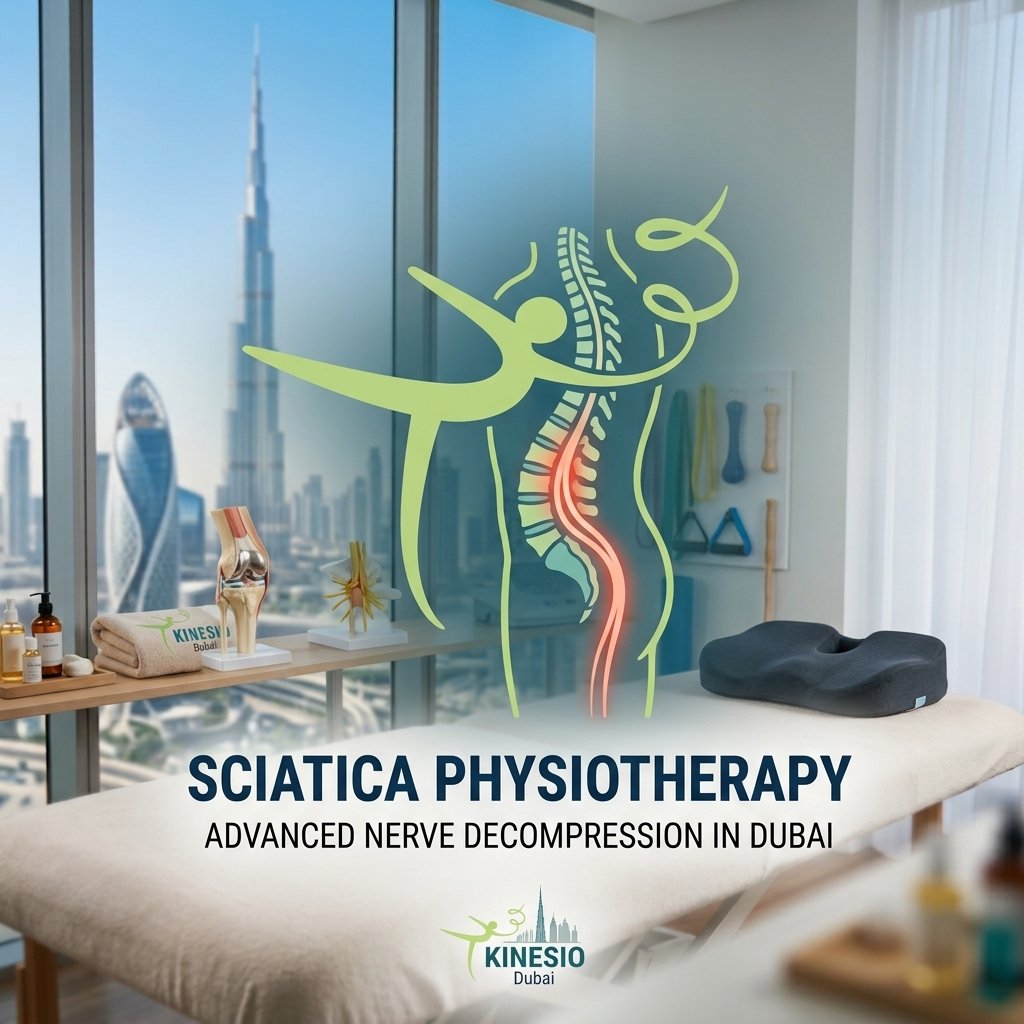
Sciatica describes a pattern of symptoms involving the sciatic nerve. The nerve runs from the lower back through the buttocks and down the leg.
The symptoms are often different from ordinary lower back pain. Sciatica may cause:
- Sharp or burning pain travelling down the leg
- Tingling or pins and needles
- Numbness
- Weakness
- Pain in the buttock or back of the leg
- Symptoms that become worse with certain movements
You may have both back pain and leg pain, but the leg symptoms are often a major feature of sciatica.
What Causes Sciatica?
Sciatica can have several possible causes.
One common cause is a herniated or slipped disc that irritates a nerve root in the lower spine. Other causes can include narrowing around the spinal nerves, vertebral problems or a back injury.
This is why simply treating the painful area is not always enough.
A physiotherapist needs to understand how your symptoms behave, what movements affect them and whether there are signs that require further medical assessment.
Is Sciatica Common in Dubai?
Sciatica is not unique to Dubai, but the demands of modern work and daily life can make lower-back and leg symptoms particularly relevant to office workers, drivers, gym-goers and active adults.
Long periods of sitting, repeated lifting, poorly managed training loads and a lack of regular movement can contribute to musculoskeletal problems.
That does not mean sitting automatically causes sciatica. The underlying cause varies between individuals, which is why assessment is important.
When Should You See a Physiotherapist for Sciatica?
Some episodes of sciatica improve over time. NHS guidance notes that sciatica often gets better within a few weeks to a few months, although it can last longer or return.
You may want to arrange a sciatica physiotherapy Dubai assessment when:
- Pain is affecting your normal daily activities
- You are struggling to sit or walk comfortably
- Symptoms continue instead of improving
- Pain keeps returning
- You have difficulty exercising
- You notice reduced movement or function
- You are unsure what is causing the leg pain
A physiotherapy assessment can help determine whether rehabilitation is appropriate and whether additional medical evaluation is needed.
How Can Physiotherapy Help Sciatica?
Physiotherapy for sciatica is generally focused on helping you stay appropriately active, improve movement and build physical capacity.
Treatment may include:
Movement Assessment
Your physiotherapist will look at your symptoms, movement patterns, strength and functional limitations.
Exercise Therapy
Exercises can be selected around your presentation and may focus on mobility, strength, trunk control and gradual return to normal activity.
Manual Therapy
Depending on the assessment, manual techniques may be included as part of a wider rehabilitation programme.
NICE recommends exercise and self-management for low back pain with or without sciatica and says manual therapy can be considered when it is delivered as part of a package that includes exercise.
Activity Modification
Rather than stopping everything, you may be advised to temporarily change activities or positions that aggravate symptoms while maintaining appropriate movement.
Education
Understanding your symptoms can make it easier to manage them confidently and avoid unnecessary fear around movement.
What Exercises Are Good for Sciatica?
There is no single exercise that works for every person with sciatica.
The right exercise depends on the cause of the symptoms, severity, movement limitations and how your leg pain responds to different positions.
General guidance supports continuing normal activities as much as possible and gradually maintaining movement rather than staying in bed or sitting for prolonged periods.
A physiotherapist may prescribe exercises involving:
- Gentle mobility
- Walking
- Core and trunk strengthening
- Hip strengthening
- Controlled spinal movement
- Nerve mobility where appropriate
- Gradual functional exercises
The important point is progression. An exercise programme should be adjusted as your symptoms and physical capacity change.
Can Walking Help Sciatica?
For many people, gentle movement such as walking can be part of staying active during recovery.
NHS guidance recommends continuing normal activities as much as possible and starting gentle exercise when able. It also advises against sitting or lying down for long periods.
However, your response to walking matters.
If a particular activity significantly increases your symptoms, a physiotherapist can help determine how to modify the activity while maintaining appropriate movement.
Should You Rest With Sciatica?
Rest may feel appealing when the pain is intense, but prolonged inactivity is generally not the goal of rehabilitation.
Appropriate movement can help maintain mobility and physical capacity while recovery takes place.
NICE recommends providing people with advice that supports self-management and encourages them to continue normal activities where appropriate.
This does not mean pushing through severe pain. The level and type of activity should be adjusted to your symptoms.
Sciatica Physiotherapy vs Massage
Massage can sometimes be used as part of treatment for musculoskeletal pain, but sciatica should not automatically be treated as a muscle problem.
The source of nerve-related symptoms may involve structures around the lower spine, so treatment needs to consider the full clinical picture.
NICE states that manual therapy, including soft-tissue techniques, may be considered for low back pain with or without sciatica, but as part of a treatment package that includes exercise rather than as a standalone approach.
Can Dry Needling Help Sciatica?
Dry needling is sometimes used as an adjunct treatment for musculoskeletal pain and muscle tension.
Kinesio Healthcare Solutions lists sciatica among conditions that may be considered for dry needling, but also states that treatment follows an assessment and is personalised to the patient’s condition.
It should not be presented as a universal treatment for sciatica. A physiotherapist should first determine whether it is appropriate for the individual.
Can Physiotherapy Prevent Sciatica From Coming Back?
Sciatica can return after an initial episode.
A rehabilitation programme can focus on factors that may reduce the risk of future problems, including:
- Maintaining strength
- Improving physical activity levels
- Building tolerance for work and exercise
- Learning safer lifting techniques
- Managing prolonged sitting
- Improving general movement habits
- Gradually increasing training loads
There is no guarantee that sciatica will never return, but maintaining an active lifestyle and developing appropriate physical capacity can form an important part of long-term management.
How Long Does Sciatica Physiotherapy Take?
There is no fixed recovery time.
Some people improve relatively quickly, while others experience symptoms for longer periods.
Recovery can depend on:
- The underlying cause
- Severity of symptoms
- Duration of the problem
- Presence of weakness or numbness
- Activity levels
- Response to treatment
- Consistency with rehabilitation
NHS guidance notes that sciatica commonly improves over a period of weeks to months, although longer-lasting symptoms can occur.
A personalised assessment provides a better basis for discussing your expected recovery than a fixed number of sessions.
Do You Need an MRI for Sciatica?
Not everyone with sciatica needs imaging.
NICE advises against routinely offering imaging in non-specialist settings for people with low back pain with or without sciatica. Imaging may be considered in specialist care when the result is expected to change management.
If your symptoms suggest that further investigation is necessary, a physiotherapist or doctor can advise you about the appropriate next step.
When Is Sciatica an Emergency?
Most cases do not require emergency treatment, but certain symptoms require urgent medical attention.
Seek urgent medical care if you develop:
- Severe or worsening weakness in both legs
- Numbness around the genitals or anus
- Difficulty starting urination
- Loss of bladder control
- Loss of bowel control
- Severe symptoms affecting both sides
These can indicate a serious spinal problem that requires urgent assessment.
Sciatica Physiotherapy in Dubai at Kinesio Healthcare Solutions
Kinesio Healthcare Solutions provides musculoskeletal and orthopedic physiotherapy in Dubai, with sciatica specifically included among the spinal conditions listed on its orthopedic physiotherapy service page.
Treatment can be tailored to the individual’s symptoms, movement limitations and recovery goals. Depending on the assessment, physiotherapy may involve therapeutic exercise, manual therapy, rehabilitation and other appropriate techniques.
The focus is on helping patients improve movement and function rather than simply treating the location where they feel pain.
For someone searching for sciatica treatment in Dubai, a proper assessment is an important first step because symptoms that look similar can have different causes.
Frequently Asked Questions
What is the best treatment for sciatica?
Treatment depends on the underlying cause and severity. Exercise, self-management and appropriate physiotherapy are commonly used approaches for many people with sciatica.
Can physiotherapy cure sciatica?
Many cases improve with conservative management, but there is no single treatment that guarantees a cure. Physiotherapy can support recovery by addressing movement, strength, activity and function.
Can sciatica go away on its own?
Yes. Sciatica often improves within weeks to months, although some cases last longer or return.
What is the difference between back pain and sciatica?
Back pain may remain around the lower back, while sciatica typically involves pain or other nerve-related symptoms travelling from the lower back or buttock into the leg.
Can I exercise with sciatica?
Appropriate exercise can form part of recovery. The type and intensity should be matched to your symptoms and physical condition.
Can sitting make sciatica worse?
Some people find sitting aggravates their symptoms, while others have different triggers. Your physiotherapist can assess which positions and movements affect your symptoms.
Does sciatica always require surgery?
No. Many people improve without surgery through conservative care. Surgery is considered in selected situations, particularly when symptoms are severe or persistent or there are specific neurological concerns.
Can a physiotherapist assess sciatica?
Yes. A physiotherapist can assess your movement, symptoms and functional limitations and determine whether physiotherapy is appropriate or whether referral for further medical assessment is needed.
Final Thoughts
Sciatica can affect much more than your lower back. Pain travelling into the leg can interfere with sitting, walking, work, exercise and sleep.
The good news is that many cases improve with appropriate conservative management, and physiotherapy for sciatica can play an important role in helping people stay active, restore movement and gradually rebuild strength.
If leg pain, numbness or tingling is continuing or affecting your daily routine, an individual assessment can help clarify what may be contributing to your symptoms and what rehabilitation approach is appropriate.