Does your knee feel fine when walking on flat ground but start hurting when you climb or go down stairs?
You are not alone. Knee pain when climbing stairs is a common complaint and can be linked to several different knee, muscle or movement-related problems.
Stairs place more demand on the knee than ordinary level walking. Going downstairs can be particularly uncomfortable because the muscles around the knee have to control your body weight as you lower yourself.
The important point is that stair pain does not automatically mean you have serious damage. It can have different causes, and the right treatment depends on what is actually contributing to your symptoms.
For people searching for knee pain physiotherapy in Dubai, a proper assessment can help identify the likely source of the problem and determine whether rehabilitation is appropriate.
Why Does My Knee Hurt on Stairs?
Walking up and down stairs requires your knee to bend while supporting your body weight.
If there is weakness, reduced mobility, irritation or poor tolerance to load around the knee, stairs may expose the problem more clearly than normal walking.
Common possibilities include:
- Patellofemoral pain
- Tendon problems
- Osteoarthritis
- Muscle weakness
- Previous knee injuries
- Meniscus problems
- Overuse
- Reduced mobility
- Changes in training or activity levels
These conditions can produce similar symptoms, which is why it is not always possible to identify the exact cause based only on where the pain is felt.
NHS guidance notes that knee pain can have many causes, including tendon problems, ligament or meniscus injuries, osteoarthritis and bursitis.
Why Is Going Downstairs Sometimes Worse?
Some people notice that walking downstairs causes more pain than walking upstairs.
This is partly because the quadriceps and other muscles around the knee have to control the body’s movement as you lower your weight onto the next step.
If the knee is sensitive to load or the surrounding muscles are not handling the demand well, this movement can make symptoms more noticeable.
Pain during stairs therefore provides useful information during a physiotherapy assessment. A physiotherapist can look at how you move rather than only asking where the knee hurts.
Is Knee Pain on Stairs a Sign of Arthritis?
Not necessarily.
Knee pain when climbing stairs can occur for many reasons, and osteoarthritis is only one possibility.
People with knee osteoarthritis may experience pain and stiffness during weight-bearing activities, but similar symptoms can occur with other knee conditions.
NICE recommends therapeutic exercise tailored to the individual as a core treatment for osteoarthritis, with exercise designed around needs such as local muscle strengthening and general aerobic fitness.
This is one reason an assessment is more useful than assuming every painful knee has the same problem.
Can Weak Muscles Cause Knee Pain?
Muscle strength can affect how well the knee tolerates everyday and sporting activities.
The quadriceps, hamstrings, gluteal muscles and other muscles around the hip and leg all contribute to lower-limb movement and control.
If the muscles are weak or deconditioned, activities such as:
- Climbing stairs
- Squatting
- Getting up from a chair
- Running
- Jumping
- Walking uphill
may become more difficult.
This does not mean weak muscles are always the cause of knee pain. They can be one of several contributing factors.
A physiotherapist can assess strength and movement and determine whether strengthening should be part of your rehabilitation plan.
What If My Knee Hurts When Bending?
Pain when bending the knee can occur with several conditions.
You may notice symptoms when:
- Squatting
- Sitting on a low chair
- Using stairs
- Kneeling
- Getting into a car
- Standing up from the floor
The location and behaviour of the pain can provide clues, but they do not provide a diagnosis by themselves.
For example, pain around the front of the knee may be different from pain along the inside or outside of the joint.
NHS information also lists different possible causes depending on the pattern of symptoms, reinforcing the importance of assessment rather than self-diagnosis.
What Is Patellofemoral Pain?
Patellofemoral pain refers to pain around or behind the kneecap.
It can become noticeable during activities that repeatedly load the knee while it is bent, including stairs, squatting and running.
Someone may experience:
- Pain around the kneecap
- Discomfort going downstairs
- Pain after prolonged sitting
- Symptoms during squatting
- Pain during running or jumping
The symptoms can sometimes improve when the activity is reduced, but the problem may return when normal activity resumes.
A rehabilitation programme can focus on improving the knee’s ability to tolerate those activities rather than simply avoiding them indefinitely.
Can Physiotherapy Help Knee Pain?
Yes. Physiotherapy for knee pain can be useful for many musculoskeletal knee problems.
Treatment starts with assessment.
A physiotherapist may examine:
- Knee movement
- Hip and ankle movement
- Muscle strength
- Balance
- Walking pattern
- Squatting and stair movement
- Pain during specific activities
- Previous injuries
- Training or activity levels
The treatment plan can then be built around the findings.
Depending on the individual, rehabilitation may involve therapeutic exercise, mobility work, strengthening, movement retraining and appropriate hands-on treatment.
What Exercises Are Used for Knee Pain?
There is no single “best knee exercise” for everyone.
Exercises should match the condition and the person’s current physical capacity.
A physiotherapy programme may include exercises designed to improve:
Quadriceps Strength
The quadriceps help control the knee during walking, stairs and other weight-bearing movements.
Hip Strength
The muscles around the hip contribute to lower-limb control during activities such as walking, running and squatting.
Knee Mobility
Improving appropriate movement can help when stiffness is limiting function.
Balance and Control
These exercises can be especially useful after injury or when the knee feels unstable.
Functional Strength
As symptoms improve, exercises may become more similar to real activities, such as step-ups, squats or controlled stair movements.
For people with osteoarthritis, NICE recommends tailored therapeutic exercise and notes that long-term adherence can help reduce symptoms and improve physical function.
Should You Stop Walking If Your Knee Hurts?
Not automatically.
Completely stopping movement is not always necessary for knee pain.
The better approach can be to temporarily reduce activities that significantly aggravate your symptoms while maintaining comfortable movement and gradually rebuilding capacity.
NHS musculoskeletal guidance advises that many knee problems improve with time, gentle movement and a gradual return to normal activity.
A physiotherapist can help determine how much activity is appropriate for your particular condition.
Should You Keep Going to the Gym With Knee Pain?
It depends on what is causing the pain and which exercises are aggravating it.
For example, you may be able to continue upper-body training while temporarily modifying certain lower-body exercises.
Rather than stopping all exercise, a rehabilitation plan may modify:
- Exercise selection
- Weight
- Repetitions
- Range of movement
- Training frequency
- Recovery time
The goal is to gradually improve your knee’s tolerance while keeping you as active as reasonably possible.
Can Physiotherapy Help Knee Pain Without Surgery?
For some knee conditions, physiotherapy can be an important part of conservative treatment.
This does not mean every knee problem can be treated without surgery.
Some injuries or structural problems may require assessment by an orthopedic specialist, imaging or other medical treatment.
However, physiotherapy can play an important role in many situations, including rehabilitation after injury and improving strength and function.
NHS guidance lists physiotherapy among possible treatments for knee pain, while the appropriate treatment depends on the underlying cause.
What Happens During Knee Physiotherapy?
Your first session normally begins with a discussion about your symptoms and goals.
Your physiotherapist may want to know:
When did the pain start?
Did it follow an injury?
Does it hurt going upstairs, downstairs or both?
Does your knee swell?
Does it lock or give way?
What activities are difficult?
Do you exercise regularly?
What treatment have you already tried?
A physical assessment can then look at movement, strength and function.
The result is a clearer picture of what may be contributing to the problem and what rehabilitation approach may be suitable.
How Long Does Knee Pain Take to Improve?
There is no single recovery timeline.
A mild overload problem may settle relatively quickly, while an injury, arthritis or persistent knee problem may require a longer rehabilitation programme.
Factors that can affect recovery include:
- Cause of the pain
- Severity
- How long symptoms have been present
- Previous injuries
- Strength and mobility
- Activity levels
- Training load
- Consistency with rehabilitation
NHS guidance advises seeking professional assessment when knee pain does not improve after a few weeks or begins affecting normal activities.
When Should You See a Physiotherapist for Knee Pain?
You should consider an assessment when:
- Knee pain keeps returning
- Stairs are becoming difficult
- You cannot exercise normally
- The knee feels weak
- Pain is affecting work or daily activities
- The knee feels stiff
- Symptoms continue for several weeks
- You are recovering from a knee injury or surgery
Getting assessed does not necessarily mean you have a serious injury.
It simply gives you a clearer understanding of what may be happening and whether physiotherapy is appropriate.
When Does Knee Pain Need Urgent Medical Attention?
Some knee symptoms require prompt medical assessment rather than routine physiotherapy.
Seek urgent medical help if your knee is very painful, badly swollen, has changed shape, you cannot put weight on it, or you cannot move it normally. A hot, red, swollen knee together with fever or feeling unwell can also require urgent evaluation.
A knee that suddenly locks, repeatedly gives way, or becomes difficult to straighten after an injury should also be assessed.
Knee Pain Physiotherapy in Dubai
If you are searching for knee pain treatment in Dubai, the first step should be understanding why your knee hurts.
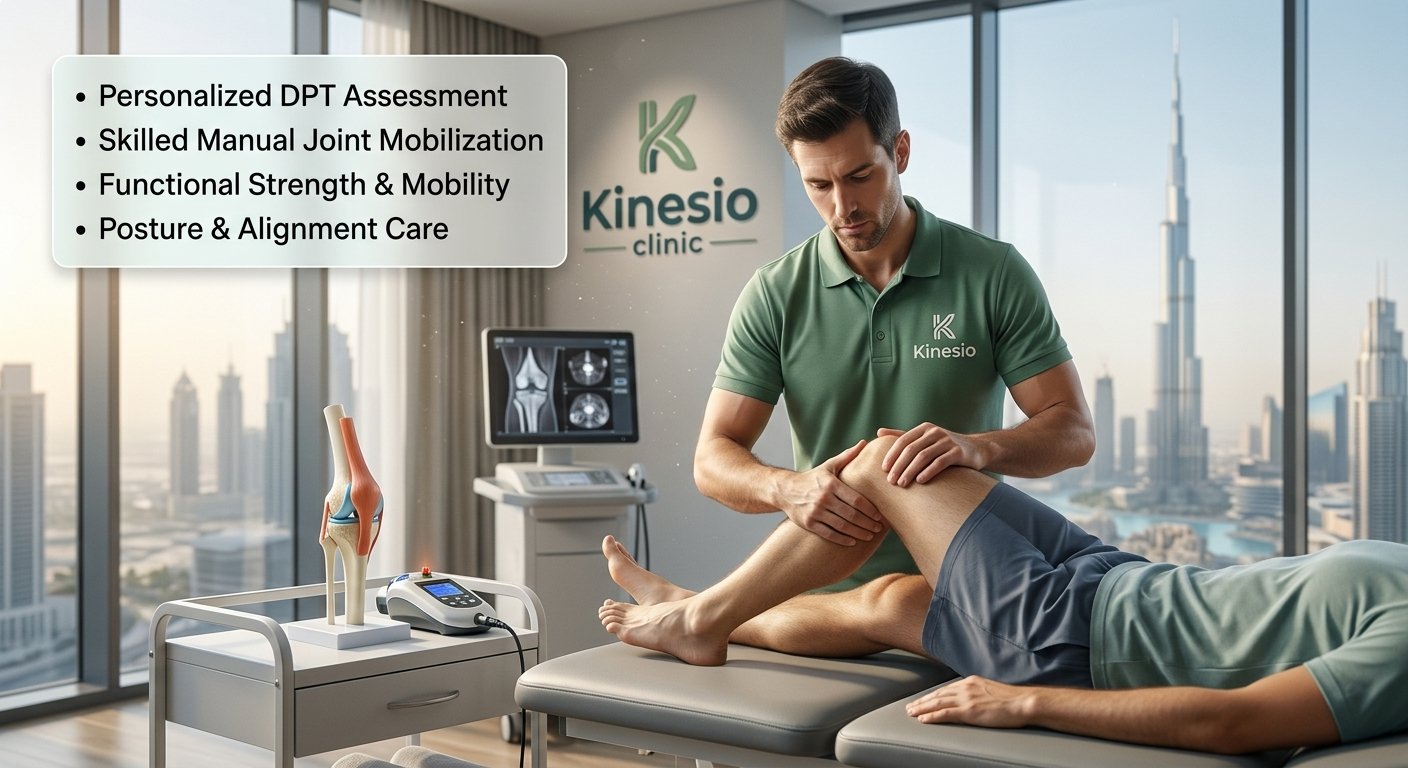
At Kinesio Healthcare Solutions, Musculoskeletal & Orthopedic Physiotherapy covers a range of conditions involving joints, muscles, tendons and other parts of the musculoskeletal system. The clinic specifically lists joint pain, sports injuries, overuse injuries, muscle weakness, arthritis, spinal conditions and post-surgical rehabilitation among the conditions it manages.
Kinesio’s approach includes personalised assessment, manual therapy techniques, specialised exercises and evidence-based rehabilitation.
This makes knee rehabilitation a natural extension of the clinic’s wider orthopedic physiotherapy service.
Why Treating the Whole Movement Matters
Your knee does not work in isolation.
The way your hip, ankle and surrounding muscles move can influence how the knee handles everyday activities.
That is why an orthopedic physiotherapy assessment may look beyond the painful area.
For example, if stair climbing is painful, rehabilitation may involve more than simply treating the knee. Your physiotherapist may also examine hip strength, ankle mobility, balance and the way you control the movement.
The aim is to improve your overall ability to move rather than only focusing on temporary symptom relief.
Frequently Asked Questions
Why does my knee hurt when I climb stairs?
Stair climbing places greater demands on the knee and surrounding muscles. Pain can be related to several conditions, including patellofemoral pain, tendon problems, osteoarthritis, previous injury or reduced strength. An assessment is needed to determine the likely cause.
Why does my knee hurt going downstairs but not upstairs?
Going downstairs requires the muscles around the knee to control your body as you lower yourself. Some people therefore notice symptoms more strongly during this movement.
Can physiotherapy fix knee pain?
Physiotherapy can help many musculoskeletal knee problems by improving strength, mobility and movement. The appropriate treatment depends on the underlying condition.
What is the best exercise for knee pain?
There is no universal best exercise. A physiotherapist can select and progress exercises based on your symptoms, strength and functional goals.
Can knee pain go away without treatment?
Some knee problems improve with time and appropriate activity modification. Persistent, recurrent or worsening symptoms should be assessed.
Is knee pain always arthritis?
No. Knee pain can have many causes, including injuries, tendon problems, bursitis, meniscus problems and other musculoskeletal conditions.
Can I exercise with knee pain?
Often, some form of exercise or movement can be maintained, but the type and intensity should be adjusted according to the condition and symptoms.
When should I see a physiotherapist for knee pain?
Consider an assessment when symptoms persist, repeatedly return or interfere with walking, stairs, exercise, work or other daily activities.
Final Thoughts
Pain on the stairs can be the first sign that your knee is struggling with a particular movement or load.
It does not automatically mean you have arthritis, a serious injury or that you need surgery.
The most useful next step is to understand what is causing the symptoms.
Knee pain physiotherapy in Dubai can provide a structured approach to assessing movement, improving strength and mobility, and gradually rebuilding your ability to perform everyday activities.
At Kinesio Healthcare Solutions, the orthopedic physiotherapy service is designed around individual musculoskeletal conditions and recovery goals, making it a relevant next step for people dealing with persistent knee pain and movement limitations.