The process of recovering from a stroke is a long one which hand-in-hand, requires a lot of patience and a consistent use of the right rehab methods for them to have a chance to be successful. The ability to gain some independence is possible by incorporating. These exercises help strengthen the patient’s body, help them gain/better their coordination, and even help them restore functional movement to the extent that the patient can perform daily activities on their own again!
Hospital-based therapy is, and should be, a big portion in the beginning of a patient’s recovery; however, therapy at home is also extremely important for the long-term success of the patient’s recovery. These stroke rehab exercises are done to help support the healing process of the the control of the patients’ muscles and to also help patients regain their cope of confidence that is needed to accomplish the daily activities that they were once able to perform before the stroke.
Stroke Recovery and The Difficulty Of Regaining Mobility
A stroke rehab exercises occurs when blood flow to the brain is interrupted. Interruption in blood flow to the brain for stroke patients causes brain damage in areas that are responsible for (or control) the patients’ ability to move, speak and coordinate themselves. Based on the patient’s stroke, a range of symptoms and loss of body functions can include, but are not limited to, the following:
- Weakness, or even paralysis, of one side of the body
- Difficulty in the ability to walk and maintain proper balance
- There is a possibility that the patient can lose some or all of the ability to control and perform functions of the hands and arms
There is a possibility that the patient can lose muscle control and suffer from muscle spasticity ( a condition that causes involuntary muscle contractions.)
Fatigue and loss of endurance
The reason it is important for patients to incorporate at-home stroke rehabilitation exercises for daily mobility into their recovery plan is to help retrain their brain and body to perform as one again. The process that allows this to happen is called neuroplasticity.
Significance of Stroke Rehabilitation at Home
Rehabilitation carried out at home has a lot of positive aspects:
- Rehabilitation can happen from the comfort of a person’s home
- Daily rehabilitation exercises can be performed
- Clinical visits can be reduced
- Rehabilitation can be integrated into a person’s daily routine
- The emotional aspect of rehabilitation can be positive
The more a person practices home stroke rehab exercises for daily mobility, the more control and movement they will regain over the basics, such as sitting, standing, walking and grasping.
Safety First: Before Starting Exercise
Before exercising at home, it is important to:
- Speak to your doctor or physiotherapist
- Prepare an exercise environment that is safe and uncluttered
- Use the necessary support chairs, walkers or rails as needed
- Do not overdo it or make sudden moves
- Rest when you feel tired.
home stroke rehab exercise for daily mobility can be a great way to regain movement, but safety is a major component
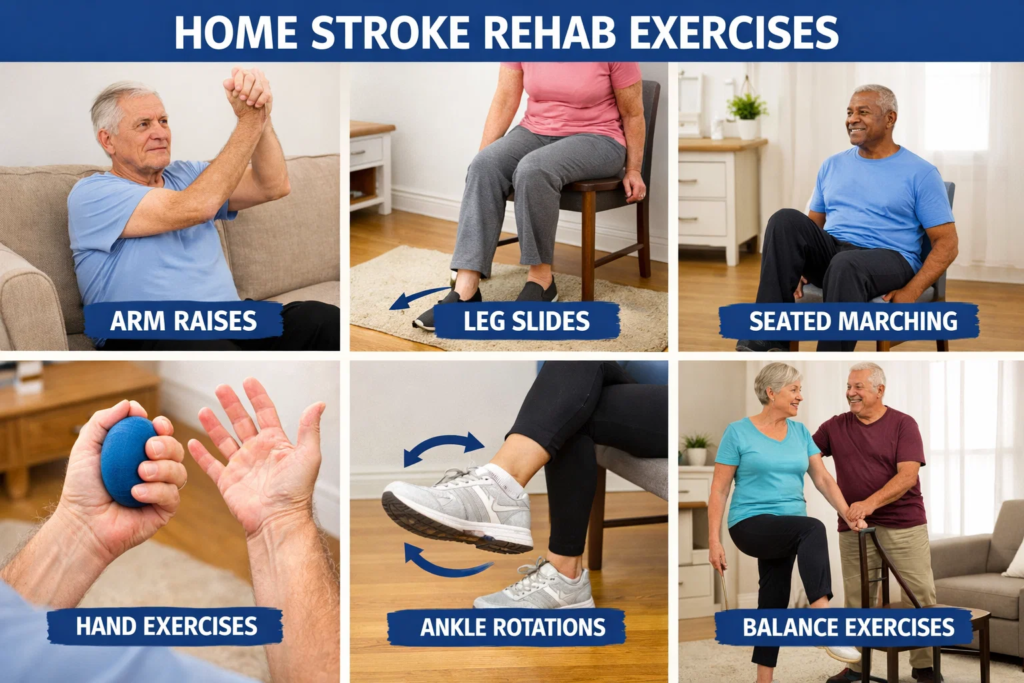
1. Exercise for Seated Marching
This neurological physiotherapy is useful for creating better strength of the legs as well as improved blood circulation.
To do:
- You should sit with your back straight in a position that has a stable and steady seat.
- One of your knees should be brought up to your chest.
- That knee should then be lowered and that same movement should be performed with the other leg.
- You should continue this until you have performed at least 10-15 repetitions.
The effects:
- Use of legs can be improved
- Coordination can be improved
- Walking ability can be improved
Many home stroke rehab exercises for daily mobility introduced in recovery begin with this exercise.
2. Mobility of Shoulders and Arm Lifting
Many basic tasks are made difficult by the condition.
How to Do It
- Sit or stand in a position where you’re comfortable
- Raise one arm straight in front of you, and then bring it up to shoulder height
- After a few seconds, bring the arm back down
- Do this 10 times on each side
Benefits
- Improves flexibility in your shoulder
- Increases the range of motion in your shoulders
- Makes it easier to perform daily activities like dressing or eating
This is a very important exercise in home stroke rehab exercises for daily mobility programs.
3. Hand Gripping and Release
A stroke can make hand function and grip strength very poor, making this exercise vital.
How to Do It
- Grab a soft ball or a towel
- Squeeze it as hard as you can for a few seconds
- Gradually let go and relax
- Do this 10 to 15 times
Benefits
- Improves grip strength
- Increases fine motor abilities
- Makes it easier to perform daily activities like using cutlery or utensils
This is a major exercise in home stroke rehab exercises for daily mobility.
4. Sit-to-Stand Practice
This exercise is excellent for regaining independence with standing and walking, as it teaches both.
How to Do It
- Find a sturdy chair and sit down
- Make sure your feet are flat on the floor
- Lean your body forward a little and then stand up
- Slowly and in a controlled way, sit back down
- Do this 5 to 10 times
Benefits
- Increases the strength of your leg muscles
- Improves your overall balance
- Builds your confidence to move
This is one of the best home stroke exercises for daily mobility.
5. Ankle Flexing Exercise
Ankle flexing is vital for proper walking stability.
How to do it:
- Sit in a comfortable position.
- Keep your legs outstretched.
- With toes pointed down to the ground, pull the toes upwards.
- Do the mentioned step with a slow and steady pace for each leg.
Benefits
- Eases the tightness/stiffness you may feel
- Enhances the ease with which you may walk.
- Better flow of blood to the legs.
- This exercise can be found in Mobility Routines for Home Rehabilitation after Stroke.
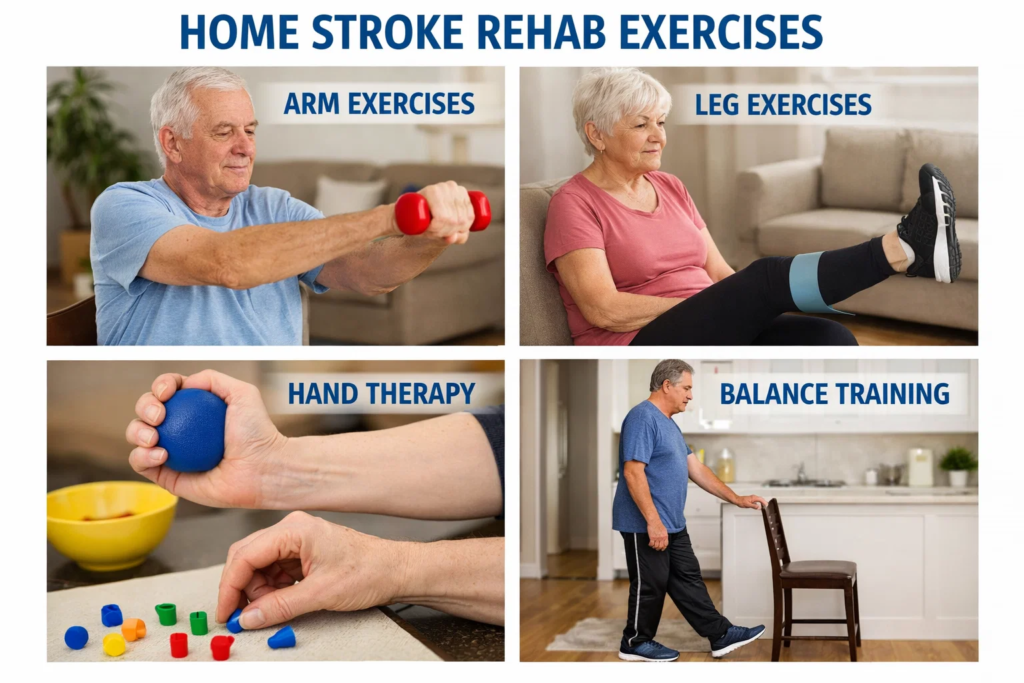
6. Once you have support, Practice Walking
One of the major achievements of a person recovering from a stroke is to be able to walk again.
How to do it:
- Use the walker, and then hold on to something for support.
- Keep the steps small and the pace slow.
- Prioritize your balance and your posture.
Little by little, your steps can increase.
Benefits
- Adds to the feeling of being independent.
- Your agility and ability to endure will increase.
- Your coordination will be better.
When healing from a stroke, practicing walking is a beneficial Mobility Routines for Home Rehabilitation after Stroke.
7. Training the Core
Setting aside time to exercise your abdomen is beneficial for balance and support your posture.
How to do it:
- Sit on a chair with the back straight.
- Keep your stomach area tight.
- Do this for a max of 5 sec and then try to relax.
- Do this for 10 sets.
Benefits:
- Your posture will improve.
- Better blood circulation to the legs.
- Risk of falling reduced.
This is an essential gait training included in mobility routines for home rehabilitation after a stroke.
Fix Exercise in Your Daily Activities
The best way to achieve your goals is by repetition. For instance, you can do the following in a day:
- Practice stretching in the morning.
- Do strength exercises in the afternoon
- Walking exercises in the evening.
A lot can be accomplished by spending 20-30 minutes on mobility routines for home rehabilitation after stroke exercises each day.
Mental and Emotional Support During Recovery
The recovery from a stroke is an emotional and mental struggle along with the physical difficulties that patients encounter. During the rehabilitation process, many become frustrated, anxious, and even depressed.
Some strategies that can help with emotional and mental rehabilitation include
- Support from family members.
- Establishing small and realistic goals.
- Documenting the process and celebrating milestones.
- Giving yourself permission to take the time necessary to heal.
An optimistic attitude can be the deciding factor that makes home neurological physiotherapy for daily mobility work.
When to Get Help from a Professional
Guidance from a professional like Kinesio.ae is critical if home exercises are resulting in:
- Increased pain
- A plateau in recovery
- Significant stiffness and muscle spasms
- Deteriorating balance
A physiotherapist would be able to refine the home stroke exercises for daily mobility to fit the individual.
Conclusion
It takes time to recover from a stroke, and it is imperative to have the right mental approach and stick with it. Home stroke rehab exercises for daily mobility are extremely important in the attempt to regain independence and a better quality of life. Resources from Kinesio ae can also provide helpful guidance and support in understanding proper movement and rehabilitation techniques.
The brain and body can be retrained by daily, simple, and structured exercises. Post-stroke recovery is possible with the right mental approach and support. Movements and tasks that need to be done daily will be easier after recovery.
FAQS
1. What are home stroke rehab exercises for daily mobility?
After a stroke, the first step in regaining independence in daily tasks is to do a series of simple exercises designed to improve movement, strength, and balance.
2. What is the recommended frequency for stroke rehab exercises to be performed at home?
They should be performed every day for 20−60 minutes, depending on how they feel and what the doctor says. Consistency is the most important thing, and it is better to be less intense because it leads to progress.
3. Can stroke patients do home exercises and fully recover?
Recovery is based on the severity of the stroke, but home exercises will help with mobility, strength, and independence. It is best if paired with professional rehab and medical supervision.
4. Are stroke exercises for patients at home safe for elderly people?
Yes, they are safe if done with the right precautions. The exercises should be done slowly and with support.
5. At what point in the stroke recovery process should one seek the help of a physiotherapist?
A physiotherapist should be sought at the point of pain, lack of progress, worsened balance and the inability to do the exercises safely at home.