A sports injury can change your routine overnight.
One day you are running, playing padel, training at the gym or preparing for a competition. The next day, a painful ankle, tight hamstring, sore shoulder or irritated knee makes ordinary movement uncomfortable.
The first question is often simple:
How can I recover and get back to my sport?
For people searching for sports physiotherapy Dubai, the answer is rarely one treatment by itself. Recovery may involve assessment, exercise rehabilitation, strength training, movement correction and carefully selected treatments such as sports massage, dry needling or kinesiology taping.
The right combination depends on the injury, the stage of recovery, the individual’s activity level and the goals they want to return to.
At Kinesio Healthcare Solutions, sports injury rehabilitation is part of a broader physiotherapy service that includes musculoskeletal and orthopedic physiotherapy, sports massage, dry needling, Kinesio taping and rehabilitation programmes.
This guide explains how those treatments can fit together and what active people in Dubai should know before returning to training after an injury.
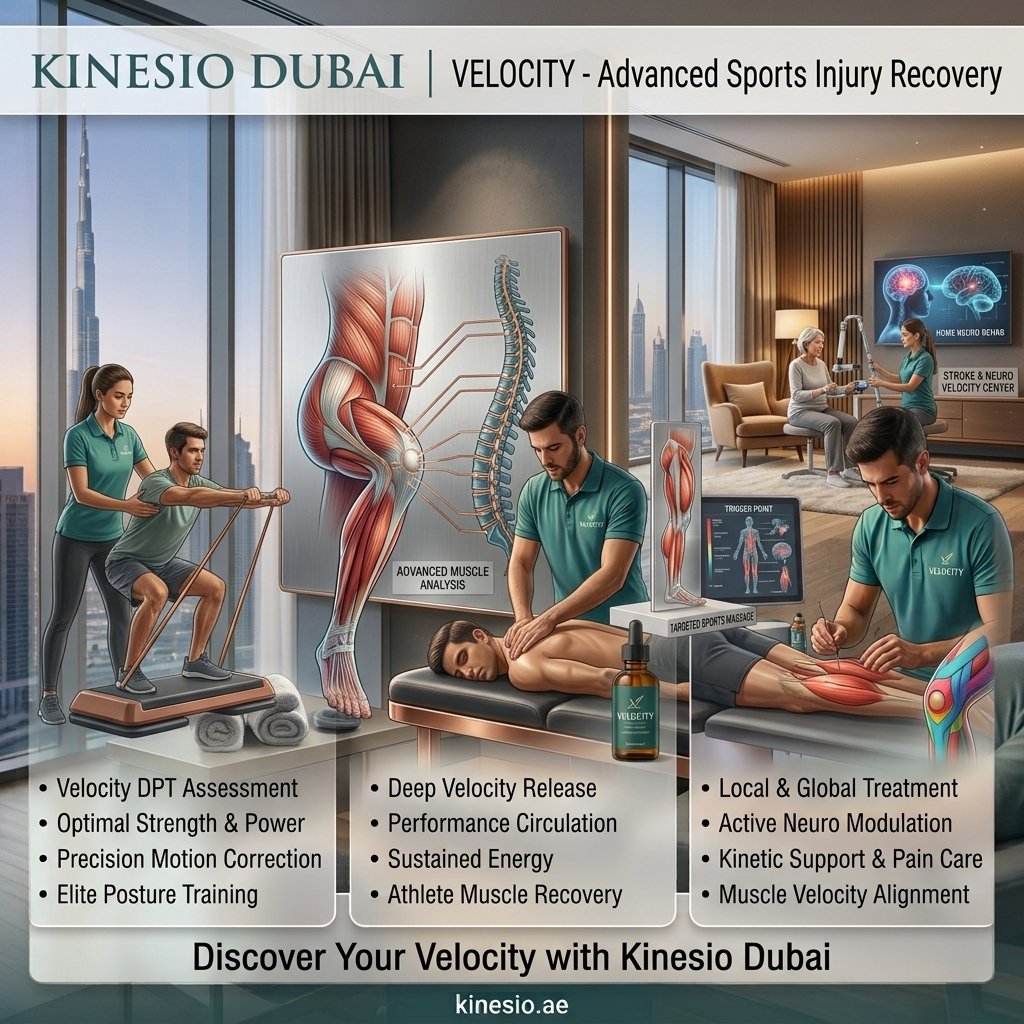
What Is Sports Injury Rehabilitation?
Sports injury rehabilitation is the process of helping an injured person restore movement, strength, confidence and physical capacity so they can gradually return to normal activities or sport.
It is not simply about reducing pain.
A person may feel better after several days but still have weakness or reduced control. Returning to full training too quickly can place the injured area under more load than it is ready to handle.
A structured rehabilitation programme may therefore progress through several stages.
Assessment
First, the injury and current symptoms are assessed.
Early Recovery
The immediate goal may be to manage symptoms and maintain appropriate movement.
Mobility
Restricted movement can be addressed where appropriate.
Strength
The muscles and injured tissues are gradually exposed to increasing loads.
Functional Training
Exercises become more similar to real-life or sporting movements.
Return to Sport
The athlete progressively returns to running, jumping, changing direction, lifting or sport-specific activity.
Dubai sports rehabilitation providers commonly describe this type of staged approach, combining assessment, exercise progression and selected hands-on treatments.
What Are the Most Common Sports Injuries?
Sports injuries can affect almost any part of the body.
Some common examples include:
- Ankle sprains
- Knee injuries
- Hamstring strains
- Calf strains
- Groin injuries
- Shoulder injuries
- Tennis elbow
- Muscle strains
- Tendon problems
- Overuse injuries
- Back and neck injuries
The activity itself can also influence the type of injury.
A runner may experience a different pattern of problems from a tennis player, footballer, weightlifter or padel player.
That is why a sports physiotherapy programme should consider the demands of your particular sport.
Kinesio’s orthopedic physiotherapy service includes sports injuries, overuse injuries, tendon problems, joint pain, muscle weakness, spinal conditions and post-surgical rehabilitation.
Why Do Sports Injuries Keep Coming Back?
One of the most frustrating experiences for an athlete is having the same injury repeatedly.
The pain may disappear, training resumes and then the problem returns.
There can be several reasons.
Perhaps strength has not fully returned.
Perhaps the training load increased too quickly.
Maybe mobility is still limited.
There may be a movement-control problem.
The athlete may also return to the same workload that originally overloaded the tissue without making any changes.
This does not mean every recurring injury is caused by one simple factor.
A physiotherapist can assess the individual’s movement, strength, training history and functional demands to identify factors that may need attention.
Current Dubai sports physiotherapy services commonly incorporate injury assessment, movement testing, progressive strengthening and load management into rehabilitation.
When Should You See a Sports Physiotherapist in Dubai?
You may benefit from sports physiotherapy Dubai when an injury is affecting your ability to train or perform normally.
A sports physiotherapy assessment can be particularly useful when:
- You have pain during training
- An injury happened suddenly
- Your movement is restricted
- The area feels weak
- You cannot perform your normal sport
- An old injury keeps returning
- You are unsure whether you are ready to return
- You need a structured rehabilitation programme
- Your performance has changed because of an injury
You do not have to be a professional athlete.
Recreational runners, gym members, padel players, football players and weekend athletes can all need sports rehabilitation.
Sports Physiotherapy vs Sports Massage
This is an important distinction for people searching for sports massage near me.
A sports massage generally focuses on muscles and soft tissues. It may be used to address muscular tension, soreness and recovery needs.
Sports physiotherapy is broader.
A physiotherapist can assess the injury, movement, strength and functional requirements and develop a rehabilitation programme.
That means a person with general post-workout tightness may choose sports massage, while someone with an ankle sprain or persistent knee pain may require physiotherapy assessment.
Current Dubai providers distinguish sports injury rehabilitation from massage while also using both within broader sports recovery services.
Neither service needs to be treated as a replacement for the other.
When Is Sports Massage Useful During Recovery?
Sports massage Dubai services can be useful when muscular tension, soreness or physical fatigue is part of the problem.
A sports massage may be considered:
- After a demanding training period
- During recovery from heavy workouts
- When specific muscles feel tight
- Between competitions
- During maintenance training
- As part of a broader recovery routine
Kinesio describes its sports massage service as being aimed at active individuals and focused on muscle tension, recovery, flexibility and performance.
However, massage should not be used automatically on every new injury.
A painful area that is swollen, significantly bruised, weak or difficult to use should be assessed before aggressive soft-tissue treatment.
What Is Massage for Muscle Recovery in Dubai?
The phrase massage for muscle recovery Dubai is often used by gym-goers and athletes looking for ways to feel less tight after training.
Recovery massage can be part of a larger programme that also includes:
- Rest
- Sleep
- Appropriate nutrition
- Hydration
- Mobility
- Strength training
- Training-load management
- Physiotherapy when needed
Massage should therefore be viewed as one tool rather than the entire recovery programme.
For example, a runner who repeatedly develops calf tightness may benefit from massage but may also need an assessment of calf strength, ankle mobility, running load and recovery habits.
What Is Dry Needling?
Dry needling Dubai is another treatment people may encounter when searching for sports injury recovery.
Dry needling uses fine needles inserted into selected muscle tissue or areas of muscle tension.
Kinesio Healthcare Solutions describes dry needling as a physiotherapy technique intended to address muscle pain and tension and help restore mobility and function.
It may be considered when a physiotherapist identifies specific muscle tension or trigger-point-related problems that could be contributing to a person’s symptoms.
It is not automatically required for every sports injury.
The decision should follow an appropriate assessment.
Dry Needling for Athletes
Athletes may develop persistent muscle tension after repeated training.
For example:
A runner may repeatedly experience tight calves.
A football player may develop recurring hamstring tension.
A tennis player may have forearm muscle tightness.
A weightlifter may develop persistent upper-body muscle tension.
Depending on the assessment, dry needling can sometimes be incorporated into a broader rehabilitation programme.
The important distinction is that the treatment does not replace progressive exercise.
If an athlete needs stronger muscles, better control or improved tolerance to training, those goals still require appropriate rehabilitation.
Kinesio states that its dry needling treatment can be used alongside rehabilitation to address muscle tension and support restoration of range of motion and function.
What Is Kinesiology Taping?
Kinesiology taping Dubai is another popular search among active people.
Kinesiology tape is elastic tape applied to the skin in specific patterns.
It differs from rigid sports tape because the elastic material allows more freedom of movement.
It may be used as an additional treatment technique during rehabilitation.
Kinesio Healthcare Solutions describes Kinesio taping as a therapeutic approach that can support muscles and joints while allowing movement. Its current service information discusses its use alongside manual therapy, therapeutic exercise and rehabilitation.
Other Dubai physiotherapy providers similarly position kinesiology taping as an adjunct to exercise and rehabilitation for selected sports injuries and movement problems.
Kinesiology Taping for Sports Injuries
Taping may be considered for selected situations involving:
- Ankle sprains
- Knee problems
- Muscle strains
- Tendon complaints
- Shoulder problems
- Joint support
- Swelling management
- Rehabilitation exercises
The exact application depends on the goal.
Tape can provide additional support or movement awareness, but it should not create the impression that the injured tissue has completely recovered.
An athlete should not return to full competition simply because tape makes the area feel more supported.
A progressive rehabilitation programme remains important.
Kinesiology Taping and Return to Training
One reason athletes use taping is that it can be incorporated into movement.
Unlike rigid immobilisation, elastic kinesiology tape is designed to move with the body.
That can make it useful in situations where an athlete needs some additional support while continuing appropriate rehabilitation.
However, whether tape is helpful depends on the injury and the individual’s response.
A physiotherapist can determine the appropriate application, amount of support and whether taping should be combined with strengthening, mobility or other rehabilitation work.
Can Sports Massage, Dry Needling and Taping Be Used Together?
In some cases, yes.
These treatments can have different roles.
Physiotherapy can assess the injury and guide rehabilitation.
Sports massage can address muscular tension and support recovery.
Dry needling can be considered for selected areas of muscle tension.
Kinesiology taping can provide additional support or movement feedback during rehabilitation.
Exercise rehabilitation builds strength, mobility, balance and physical capacity.
Dubai sports injury clinics commonly combine several of these approaches rather than relying on one technique.
This is important because recovery is a process.
What Is a Complete Sports Recovery Program?
People searching for the best workout recovery program in Dubai may expect one treatment or one weekly routine.
In reality, a useful recovery programme needs to reflect the athlete.
A practical programme may include five areas.
1. Training Load
Your body needs enough recovery between demanding sessions.
Increasing training volume, intensity or frequency too quickly can make it harder for tissues to adapt.
2. Strength
Strength training can help build the physical capacity required by your activity.
3. Mobility
Appropriate mobility work can help you maintain comfortable movement.
4. Recovery
Sleep, nutrition, hydration and rest all contribute to recovery.
5. Targeted Treatment
Physiotherapy, sports massage, dry needling or taping may be included when appropriate.
This is more useful than looking for one universal “best” recovery treatment.
How Long Does Sports Injury Recovery Take?
There is no single recovery timeline.
An uncomplicated muscle strain may follow a different path from an ACL injury, tendon problem or fracture.
Recovery can depend on:
- Type of injury
- Severity
- Location
- Previous injury history
- Strength
- Mobility
- Training load
- Rehabilitation consistency
- Sport-specific requirements
A calendar date alone should not determine whether an athlete is ready to return.
Functional progress matters.
How Do You Know When You Are Ready to Return to Sport?
Feeling less pain does not always mean the injury has fully recovered.
Before returning to unrestricted sport, an athlete may need to demonstrate appropriate:
- Strength
- Range of movement
- Balance
- Coordination
- Sport-specific movement
- Load tolerance
- Confidence
For example, returning to football may require more than comfortably walking.
You may need to tolerate running, acceleration, deceleration, jumping, cutting and kicking.
A tennis or padel player may need to tolerate repeated changes of direction, lunging and upper-limb loading.
A rehabilitation plan should therefore progress toward the actual demands of the sport.
Sports physiotherapy providers in Dubai describe staged return-to-sport planning and progressive exercise as part of sports rehabilitation.
What Are the Biggest Mistakes After a Sports Injury?
Returning Too Quickly
Feeling better for a few days does not necessarily mean the tissue is ready for unrestricted training.
Completely Stopping Movement
For many injuries, complete inactivity is not the long-term goal. Rehabilitation usually involves an appropriate progression of movement.
Only Treating Pain
Pain reduction is useful, but strength and function matter too.
Relying Only on Massage
Massage can be useful for selected recovery needs, but it does not replace injury assessment or strengthening.
Using Tape as a Cure
Taping can be a useful adjunct but should not replace rehabilitation.
Ignoring Recurring Symptoms
Repeated pain is a reason to investigate contributing factors rather than repeatedly starting from zero.
When Should You Choose Sports Physiotherapy Instead of Massage?
A useful distinction is to ask what your main problem is.
Choose sports physiotherapy when:
You have a specific injury.
You have weakness.
Your movement is restricted.
You cannot perform your sport normally.
You need rehabilitation after surgery.
Your injury keeps coming back.
You need guidance on returning to training.
Sports massage may be useful when:
You mainly have muscle tightness.
You have post-workout soreness.
You want recovery-focused soft-tissue treatment.
You have muscular fatigue without signs of a significant injury.
Dry needling may be considered when:
A physiotherapy assessment identifies selected muscle tension or trigger points that may respond to the technique.
Kinesiology taping may be considered when:
Additional support or movement feedback may be useful during rehabilitation.
These categories can overlap.
What Sports Physiotherapy Can Do for Runners
Running repeatedly loads the lower limbs.
A runner dealing with recurring symptoms may need more than treatment to the painful area.
A sports physiotherapy assessment can consider:
- Running habits
- Training volume
- Recovery
- Strength
- Lower-limb movement
- Previous injuries
- Return-to-running progression
Rehabilitation may then progress through walking, controlled running, strengthening and sport-specific loading.
Sports injury clinics in Dubai increasingly describe exercise progression and running analysis as part of their sports rehabilitation services.
Sports Injury Recovery for Padel and Tennis Players
Padel and tennis involve repeated changes of direction, lunging, jumping, rotation and upper-limb movement.
Potential problems can involve:
- Elbow
- Shoulder
- Knee
- Ankle
- Calf
- Hamstring
- Lower back
A sports rehabilitation programme should consider the actual movement requirements of the sport.
For example, an athlete returning after an ankle injury may need balance, strength and change-of-direction work before returning to competitive play.
A tennis or padel player recovering from an elbow or shoulder problem may need progressive upper-limb loading before returning to repeated hitting.
Dubai Clinic for Sports Injuries: What Should You Look For?
When searching for a Dubai clinic for sports injuries, look beyond the word “sports” in the clinic name.
Consider whether the clinic provides:
- Clinical assessment
- Sports physiotherapy
- Exercise rehabilitation
- Return-to-sport planning
- Strength and mobility training
- Sports massage
- Dry needling
- Kinesiology taping
- Appropriate referral when necessary
Current Dubai sports rehabilitation services commonly combine these elements into personalised programmes.
Kinesio Healthcare Solutions lists sports injury rehabilitation together with musculoskeletal and orthopedic physiotherapy, sports massage, dry needling and Kinesio taping.
Kinesio Healthcare Solutions for Sports Recovery in Dubai
Kinesio Healthcare Solutions is a physiotherapy and rehabilitation clinic in Dubai offering musculoskeletal, orthopedic, sports and neurological physiotherapy services.
Its current service offering includes:
- Musculoskeletal and orthopedic physiotherapy
- Sports injury rehabilitation
- Sports massage
- Dry needling
- Kinesio taping
- Postural education
- Neurological physiotherapy
The clinic’s sports massage service is specifically positioned around recovery, muscle tension, flexibility and active lifestyles.
Its dry needling service focuses on selected muscle-related problems, including muscle tension and restricted movement.
Its orthopedic physiotherapy service provides broader rehabilitation for sports injuries, joint problems, muscle weakness, tendon problems and other musculoskeletal conditions.
This combination means that treatment can be adapted as recovery progresses.
What Happens During a Sports Physiotherapy Assessment?
Your first appointment should begin with understanding the injury.
Your physiotherapist may ask:
How did the injury happen?
When did the pain begin?
What activities make it worse?
What can you currently do?
What sport do you play?
How often do you train?
Have you had the same injury before?
What is your goal?
The physical assessment may then look at movement, mobility, strength, balance and functional tasks.
The purpose is to establish where you are now and what needs to improve before progressing.
How Sports Massage Fits Into Physiotherapy
A sports massage can be useful alongside rehabilitation rather than instead of rehabilitation.
For example, imagine an athlete completing a strengthening programme after a lower-limb injury.
The exercises are helping rebuild capacity, but certain muscles remain tight after training.
A sports massage may then be incorporated to address muscular tension and support the athlete’s broader recovery routine.
The important thing is that the massage has a role within the overall plan.
How Dry Needling Fits Into Rehabilitation
Dry needling is similarly best considered as a treatment technique rather than the entire rehabilitation programme.
If a physiotherapist identifies a specific area of muscle tension, dry needling may be considered where appropriate.
After that, the athlete may still need:
- Strength exercises
- Mobility exercises
- Movement training
- Functional exercises
- Sport-specific drills
Kinesio describes dry needling as supporting mobility and muscle function within its wider rehabilitation approach.
How Kinesiology Taping Fits Into Rehabilitation
Kinesiology tape can provide additional support while the athlete continues an appropriate rehabilitation programme.
It may be especially useful when an athlete needs some additional assistance with movement or wants support during a specific phase of recovery.
However, tape should complement rehabilitation rather than replace it.
The goal is ultimately to improve physical capacity so that the athlete does not have to depend on tape for every activity.
Frequently Asked Questions
What is sports physiotherapy in Dubai?
Sports physiotherapy focuses on the assessment, treatment and rehabilitation of sports-related injuries and movement problems. It can include exercise rehabilitation, manual therapy and selected techniques such as dry needling or taping.
Is sports massage good after a workout?
Sports massage may help with muscular tension and recovery after demanding physical activity. The appropriate timing and intensity depend on the individual.
How do I find sports massage near me?
Search for a provider in your Dubai area and check that the therapist understands sports recovery and can recognise when an injury needs physiotherapy assessment.
Is sports massage the same as physiotherapy?
No. Sports massage primarily focuses on soft tissues and muscle tension, while physiotherapy involves assessment and rehabilitation of movement and function.
What is dry needling in Dubai?
Dry needling is a physiotherapy technique using fine needles on selected muscle areas. It may be considered for specific muscle tension and related musculoskeletal problems.
Does dry needling replace physiotherapy?
No. It is generally used as one technique within a wider physiotherapy programme when appropriate.
What is kinesiology taping in Dubai?
Kinesiology taping involves applying elastic tape to the skin to provide selected support or movement feedback during rehabilitation. It is commonly used alongside other physiotherapy approaches.
Can kinesiology taping heal a sports injury?
Taping should not be considered a standalone cure. It can be used as an adjunct to rehabilitation when appropriate.
What is the best workout recovery program in Dubai?
There is no universal programme that suits every athlete. A complete programme may combine training-load management, strength, mobility, sleep, nutrition, recovery and selected treatments based on individual needs.
How long does a sports injury take to recover?
Recovery depends on the injury and the individual. Returning to sport should be based on appropriate function and physical capacity rather than a fixed calendar date.
Should I get massage immediately after a sports injury?
Not automatically. Significant swelling, bruising, weakness, severe pain or difficulty using the injured area may require assessment before massage.
Can physiotherapy prevent sports injuries?
A physiotherapist can identify factors such as weakness, mobility restrictions, movement-control issues and inappropriate training loads that may contribute to injury risk. Prevention strategies vary between individuals.
Is sports physiotherapy only for professional athletes?
No. Recreational athletes and active adults can also benefit from sports injury assessment and rehabilitation.
Can sports massage and dry needling be used together?
They can sometimes be included in the same broader recovery programme, depending on the patient’s condition and the clinician’s assessment.
Final Thoughts
Recovering from a sports injury is more than getting the pain to settle.
The real objective is to restore the strength, movement, confidence and physical capacity needed to return to the activity that matters to you.
For some athletes, sports physiotherapy Dubai will be the main part of that process.
For others, sports massage Dubai may be useful for muscular recovery and tightness.
When specific muscle tension is contributing to symptoms, dry needling Dubai may be considered as an additional physiotherapy technique.
And when selected support or movement feedback is useful, kinesiology taping Dubai may form part of rehabilitation.
The treatments work best when they have a clear purpose.
A runner should eventually be able to run.
A football player should be able to accelerate, stop and change direction.
A padel player should be able to lunge and rotate.
A gym-goer should be able to progressively return to their normal exercises.
That is why rehabilitation should be based around function rather than simply the number of treatments received.
Kinesio Healthcare Solutions brings musculoskeletal and orthopedic physiotherapy, sports injury rehabilitation, sports massage, dry needling and Kinesio taping together within its Dubai physiotherapy and rehabilitation services.
For someone searching for a Dubai clinic for sports injuries, the most useful starting point is a proper assessment that identifies the current problem and creates a realistic path back to activity.
Recovery is not about rushing back.
It is about building back the capacity to perform safely and confidently.