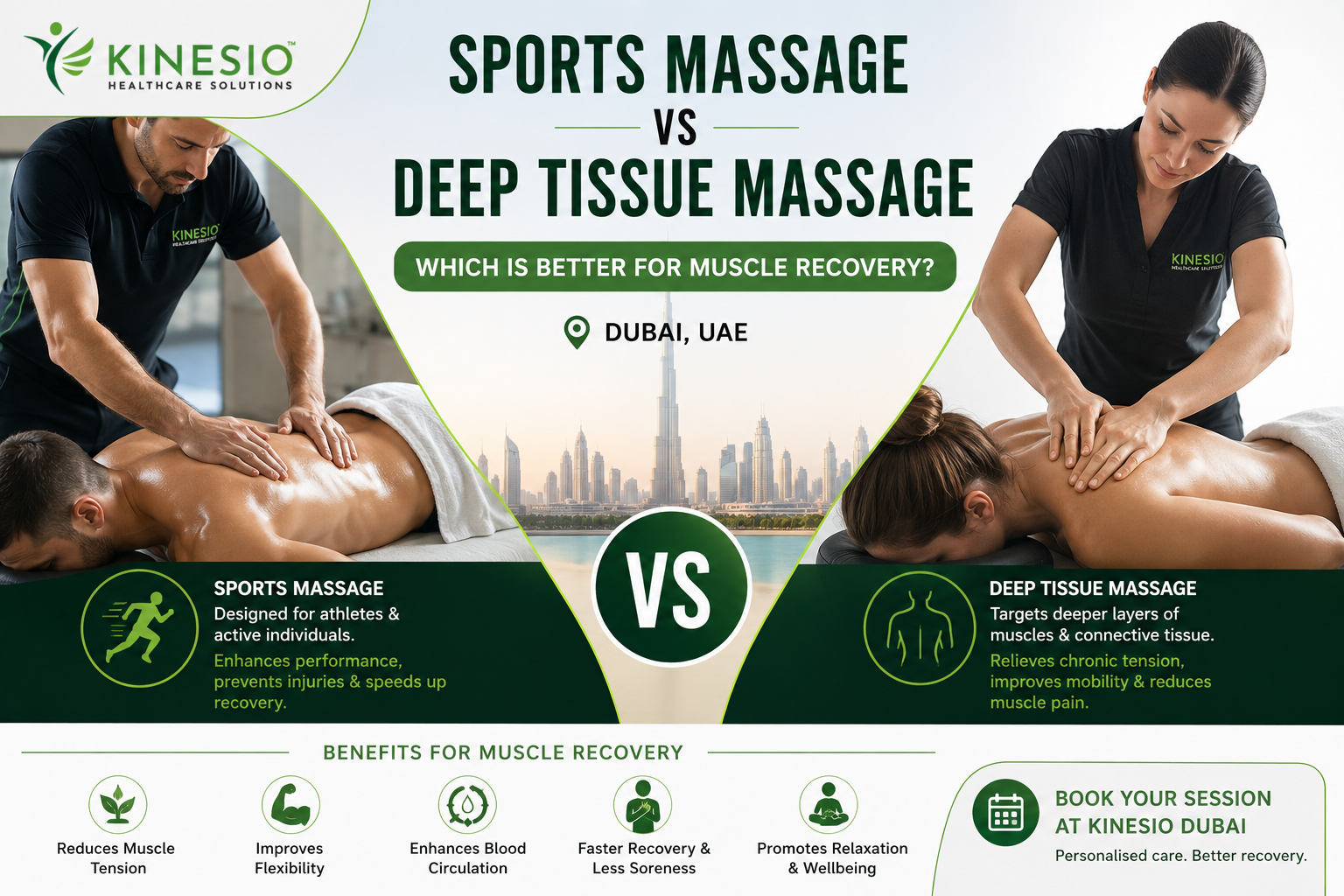
If your muscles feel tight, sore or worn out after training, you may be wondering whether you need a sports massage or deep tissue massage. Although both techniques can involve firm pressure and are often used for muscle discomfort, they are not exactly the same.
Sports massage is generally designed around the needs of active people, training, recovery and sports-related muscle problems, while deep tissue massage focuses more broadly on deeper layers of muscle and connective tissue.
The right choice depends on why you are seeking treatment, your activity level, the area causing discomfort and your overall recovery needs.
For athletes and active individuals in Dubai, understanding the difference can help you choose a treatment that fits your goals rather than simply choosing the massage that feels stronger.
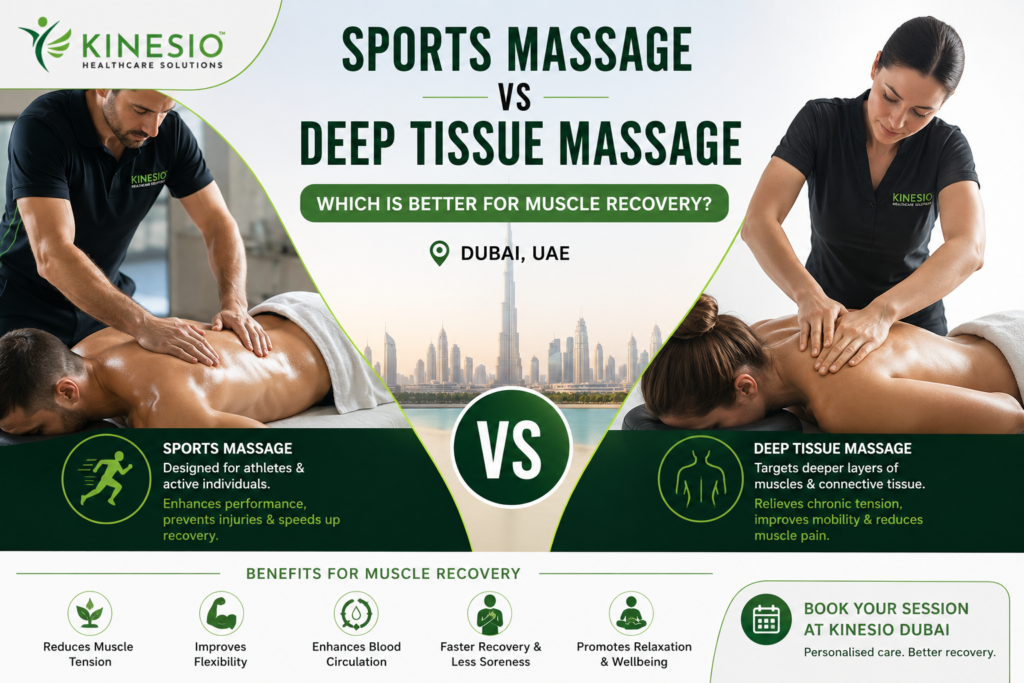
Sports Massage vs Deep Tissue Massage: Quick Answer
The main difference is the purpose and treatment approach.
A sports massage is typically tailored to people who participate in sport or regular physical activity. It may be used before or after training, during recovery, or alongside rehabilitation for certain sports-related problems.
A deep tissue massage uses slower, firmer techniques to address areas of muscle and connective-tissue tension. It isn’t exclusively for athletes and may be chosen by people experiencing persistent muscular tightness or general muscle discomfort.
Neither treatment is automatically better.
If your main goal is sports recovery, managing training-related muscle tightness or supporting athletic performance, sports massage may be more appropriate.
If your concern is general muscular tension or areas that feel persistently tight, a deep tissue approach may be worth discussing with a qualified practitioner.
What Is a Sports Massage?
A sports massage is a type of massage treatment commonly used by athletes and physically active people.
Despite the name, you don’t have to be a professional athlete to consider one.
It may be useful for people who regularly participate in:
- Running
- Gym workouts
- Football
- Tennis
- Padel
- Cycling
- Swimming
- Strength training
- Other recreational sports
The treatment can be adapted according to your activity, training schedule and areas of muscular tension.
For example, a runner may have different recovery needs from someone who spends several hours playing padel or lifting weights at the gym.
A sports massage may therefore focus on the muscles and areas that are being repeatedly loaded during a person’s chosen activity.
What Is Deep Tissue Massage?
Deep tissue massage generally uses slower strokes and firmer pressure to work on deeper layers of muscle and connective tissue.
It is often considered when someone has areas of persistent muscular tightness or tension.
Common reasons people seek this type of massage include:
- Muscle tension
- General stiffness
- Localised muscular discomfort
- Tight muscles after physical activity
- Areas that feel chronically tense
- Recovery from physically demanding activities
One important misconception is that deeper pressure automatically means a better massage.
It doesn’t.
A massage should be appropriate for the individual’s condition and tolerance. Excessive pressure can leave someone feeling unnecessarily sore and isn’t necessarily more effective.
Sports Massage vs Deep Tissue Massage: The Main Differences
Although there is some overlap between the techniques, their overall focus can be different.
| Sports Massage | Deep Tissue Massage |
|---|---|
| Commonly tailored to active people | Used for a wider range of people |
| Often connected with sports recovery | Often focused on muscular tension |
| Can be adapted around training | May target persistent areas of tightness |
| Can consider a person’s sport and activity | Generally focuses on areas requiring deeper work |
| May complement rehabilitation | May be used for general muscular discomfort |
| Can be part of an athlete’s recovery routine | Can be considered when muscles feel persistently tense |
The distinction isn’t always black and white.
An experienced practitioner may use different massage techniques depending on what they find during an assessment.
Which Is Better for Muscle Recovery?
If your primary goal is muscle recovery after sports or regular training, sports massage may be the more natural choice.
The reason is simple: sports massage can be adapted around your activity.
For example, treatment for a runner may focus on areas that experience repeated loading during running, while a football player may have different muscular demands.
Your treatment can also take into account:
- Your training schedule
- Current muscle soreness
- Previous injuries
- Areas of tightness
- Sport-specific demands
- Recovery goals
However, massage shouldn’t replace appropriate recovery habits such as sleep, hydration, sensible training loads, mobility work and strength training.
Sports Massage for Athletes
Athletes often put their muscles under repeated physical stress.
Training creates a cycle of:
Exercise → Physical stress → Recovery → Adaptation
Massage may be used as one part of the recovery process.
A sports massage can be particularly relevant when an athlete notices areas of muscular tightness after repeated training sessions.
For example:
Runners
Runners may experience recurring tightness around the calves, hamstrings, glutes or thighs.
Football players
Football involves sprinting, acceleration, changes of direction and repeated lower-body loading.
Padel and tennis players
Racquet sports can place considerable demands on the legs, shoulders, forearms and trunk.
Gym and strength-training enthusiasts
Heavy or repetitive training can leave particular muscle groups feeling tight or fatigued.
The treatment should still be individualised rather than following the same routine for everyone.
Sports Massage for Muscle Soreness
It is common to look for a massage after a hard workout when muscles feel sore.
But not every type of post-exercise soreness needs treatment.
Normal muscle soreness can occur after unfamiliar or demanding exercise. It generally improves with time and appropriate recovery.
If soreness is severe, persistent, associated with significant swelling, weakness or an injury, it’s better to seek an appropriate clinical assessment rather than simply booking a stronger massage.
This is especially important when pain started suddenly during exercise.
Is Deep Tissue Massage Better for Tight Muscles?
Not necessarily.
Deep tissue techniques may be appropriate for some types of muscular tension, but more pressure does not always mean better results.
A skilled practitioner should consider:
- How tight the muscle actually is
- Whether there is an underlying injury
- Your pain tolerance
- The location of the discomfort
- Your activity level
- Whether another treatment would be more appropriate
If a muscle is painful because of an underlying injury, simply applying deeper pressure may not address the actual problem.
This is one reason assessment matters.
Sports Massage Before or After Exercise?
The answer depends on what you’re trying to achieve.
A massage performed around physical activity may be approached differently depending on whether the goal is preparation or recovery.
Before exercise
Some athletes may use lighter, activity-specific techniques as part of preparation.
The objective isn’t necessarily to provide a long, intense massage immediately before demanding exercise.
After exercise
Post-training massage may focus more on recovery and areas that feel tight after activity.
The timing and intensity should be appropriate for the person’s training programme.
If you’re unsure whether massage is suitable before or after your workout, discuss your training schedule with the practitioner.
Sports Massage vs Deep Tissue Massage for Back Pain
Both sports massage and deeper massage techniques may be considered when muscular tension contributes to back discomfort.
But back pain has many possible causes.
Pain can be associated with muscles, joints, discs, nerves, movement patterns, previous injuries or other factors.
That means massage isn’t automatically the correct treatment for every case of back pain.
If your back pain is persistent, severe, worsening or accompanied by symptoms such as significant weakness, numbness or other concerning changes, seek appropriate medical advice.
For ongoing musculoskeletal problems, a physiotherapy assessment can help determine whether massage, exercise therapy, manual therapy or another approach is more appropriate.
Can Sports Massage Prevent Sports Injuries?
This question needs a careful answer.
Sports massage may be useful as part of an athlete’s overall recovery routine, but it should not be presented as a guarantee against injury.
Sports injury prevention involves multiple factors, including:
- Appropriate training progression
- Strength
- Mobility
- Technique
- Recovery
- Sleep
- Training load
- Previous injury management
- Sport-specific preparation
If you repeatedly experience the same pain during training, the better approach may be to investigate why it keeps happening rather than relying on massage alone.
Sports Massage and Physiotherapy: Are They the Same?
No.
Massage and physiotherapy can overlap in some treatment settings, but they are not the same thing.
Sports massage primarily focuses on massage-based treatment and recovery.
Physiotherapy involves assessment, diagnosis within the practitioner’s scope, rehabilitation and management of movement and musculoskeletal problems.
A physiotherapy programme may include:
- Exercise therapy
- Strengthening
- Mobility exercises
- Manual therapy
- Movement retraining
- Education
- Load management
- Appropriate hands-on techniques
For an athlete recovering from an injury, sports massage may be one component of a broader rehabilitation programme rather than the complete solution.
When Should You Choose Sports Massage?
Sports massage may be worth considering if you:
- Train regularly
- Participate in competitive or recreational sports
- Experience recurring muscular tightness
- Want support with post-training recovery
- Have demanding physical activity requirements
- Want treatment tailored around your sport
It can also be useful for active people who don’t consider themselves athletes.
You don’t need to run marathons or compete professionally to have sports-related recovery needs.
When Might Deep Tissue Massage Be More Appropriate?
A deeper massage approach may be considered when your main concern is persistent muscular tension rather than sport-specific recovery.
For example, someone who spends long periods sitting at a desk may experience muscular tightness around the neck, shoulders or back.
Another person may develop muscular tension after physically demanding work.
The appropriate technique depends on the individual.
Sports Massage in Dubai: What Should You Look For?
If you’re searching for sports massage in Dubai, don’t judge a clinic solely by how much pressure its therapists use.
Look for a provider that focuses on your individual needs.
Consider the following:
1. Practitioner experience
Ask about the practitioner’s qualifications and experience with active clients.
2. Personalised treatment
Your treatment should reflect your activity, symptoms and goals.
3. Understanding of sports
Different activities place different demands on the body.
4. Rehabilitation options
If you have an injury rather than simple muscle tightness, you may need more than massage.
5. Appropriate assessment
Recurring pain deserves proper assessment instead of repeatedly treating the same painful area.
Sports Massage for Padel Players in Dubai
Padel has become a popular recreational sport, and the repeated changes of direction, acceleration, rotation and overhead movements can place demands on different parts of the body.
A padel player’s recovery needs may involve:
- Calves
- Hamstrings
- Quadriceps
- Glutes
- Lower back
- Shoulders
- Forearms
A sports massage can be tailored around these demands when appropriate.
However, persistent pain should not simply be massaged repeatedly. If an injury is suspected, a physiotherapy assessment may be more appropriate.
Sports Massage for Runners in Dubai
Running places repetitive loads through the lower body.
Runners commonly pay attention to areas such as:
- Calves
- Hamstrings
- Quadriceps
- Glutes
- Hip muscles
Sports massage may form part of a runner’s recovery routine, particularly when muscular tightness is affecting comfort or training.
For recurring running pain, however, it is important to consider factors such as running volume, footwear, training progression, strength and biomechanics rather than relying solely on massage.
How Often Should You Get a Sports Massage?
There is no universal number of sports massages that every athlete needs.
Frequency can depend on:
- Training volume
- Competition schedule
- Recovery demands
- Previous injuries
- Muscle tightness
- Personal preference
- Overall rehabilitation programme
Someone training once or twice a week may have very different needs from an athlete training every day.
Your treatment frequency should therefore be based on your circumstances rather than following a fixed schedule from the internet.
Can You Combine Sports Massage With Physiotherapy?
Yes, depending on your individual situation.
Massage can sometimes complement physiotherapy when someone needs both hands-on recovery work and an active rehabilitation programme.
For example:
Sports injury → Physiotherapy assessment → Rehabilitation programme → Appropriate sports massage → Progressive return to activity
This approach focuses on the bigger picture rather than treating symptoms in isolation.
Why Choose Kinesio Healthcare Solutions in Dubai?
At Kinesio Healthcare Solutions, sports massage sits within a broader physiotherapy and rehabilitation environment.
That matters when you’re not simply looking for a relaxing massage but are dealing with training-related muscle tightness, sports recovery needs or an ongoing musculoskeletal concern.
The appropriate treatment can depend on your symptoms, activity and goals.
If your concern appears to involve an injury rather than ordinary post-training tightness, a physiotherapy assessment can help determine the next step.
For people searching for sports massage in Dubai, Kinesio can help you understand which approach may be appropriate for your needs.
Ready to discuss your recovery needs? Contact Kinesio Healthcare Solutions in Dubai and arrange an assessment or sports massage appointment.
Frequently Asked Questions
Is sports massage better than deep tissue massage?
Neither is universally better. Sports massage is generally tailored toward active people and sports recovery, while deep tissue massage is commonly used for deeper muscular tension. The right option depends on your individual needs.
What is the difference between sports massage and deep tissue massage?
Sports massage is typically adapted around physical activity, sports recovery and an individual’s training demands. Deep tissue massage generally uses slower, firmer techniques to address deeper muscular and connective-tissue tension.
Is sports massage good for muscle recovery?
Sports massage can be incorporated into a recovery routine for active people. Recovery also depends on appropriate training, rest, sleep, nutrition, hydration and managing training loads.
Does deep tissue massage help tight muscles?
It may help some people with muscular tension, but deeper pressure isn’t automatically better. The appropriate technique should depend on the person’s symptoms and tolerance.
Should I get a sports massage before or after exercise?
The approach can differ depending on whether the goal is preparation or recovery. Massage immediately before intense activity should generally not be unnecessarily aggressive.
How often should athletes get sports massage?
There is no single schedule that works for every athlete. Frequency depends on training volume, recovery needs, symptoms, competition schedules and individual goals.
Is sports massage painful?
It can involve firm pressure, but treatment should remain appropriate and tolerable. Severe or unnecessary pain isn’t a sign that the massage is working better.
Can sports massage help runners?
Sports massage may be incorporated into a runner’s recovery routine, particularly when muscular tightness is an issue. Persistent running pain should be properly assessed.
Is sports massage good for padel players?
It may be useful as part of recovery for active padel players. However, recurring pain should be assessed rather than repeatedly treated with massage alone.
Can sports massage prevent injuries?
Massage should not be considered a guarantee against injury. Injury prevention involves appropriate training progression, strength, mobility, recovery and management of previous injuries.
Can I have sports massage if I have an injury?
It depends on the injury. Some injuries may require physiotherapy or medical assessment before massage is appropriate.
Should I choose sports massage or physiotherapy?
Choose based on your goal. Sports massage may be appropriate for recovery and muscular maintenance, while physiotherapy is more appropriate when you need assessment and rehabilitation for a musculoskeletal problem.
Can sports massage and physiotherapy be used together?
They can complement each other in some situations. A physiotherapist can help determine whether massage fits into your overall rehabilitation plan.
Is sports massage only for professional athletes?
No. Recreational runners, gym users, padel players and other active people can also seek sports massage.
Where can I get sports massage in Dubai?
Kinesio Healthcare Solutions provides sports massage within its physiotherapy and rehabilitation services in Dubai. Contact the clinic to discuss your requirements and determine the appropriate treatment approach.
Final Takeaway
Sports massage and deep tissue massage can both be useful for muscular tension and recovery, but they have different areas of focus.
Sports massage is particularly relevant to active people because treatment can be adapted around their sport, training and recovery requirements.
Deep tissue massage may be more appropriate when the primary concern is persistent muscular tension and deeper tissue work is considered suitable.
If you’re unsure which treatment you need, don’t choose based on pressure alone.
A personalised assessment can help you determine whether sports massage, physiotherapy, deep tissue techniques or a combination of approaches makes the most sense for you.
If you’re looking for sports massage in Dubai, Kinesio Healthcare Solutions can help you choose an approach based on your individual activity, symptoms and recovery goals.
Medically Reviewed Content
This article provides general educational information about sports injuries, rehabilitation, and recovery. Recovery timelines and exercise recommendations vary by injury severity and individual circumstances. A personalized assessment is recommended before beginning or progressing a rehabilitation programme.
Author: Kinesio Healthcare Solutions Editorial Team